Friday, 14 September 2012

A Plugged Well


Well, well, well ... well... well ....
A little while ago Matt Dawson got in touch with me and asked if I’d be interested in acquiring a copy of his IPP32 exchange puzzle, and whether any of my puzzling mates over this side of the pond might like one as well to make the shipping worthwhile. The email included a picture of a wood and brass puzzle very loosely resembling an oil well with what looked like a drawer on the front of the base. Matt described it as a sequential discovery puzzle and sounded quite excited about it ... so I fired an email around to the usual suspects and pretty soon I’d let Matt know that I had lined up nine takers, including myself – and a little while later a decent-sized box arrived with nine little wooden oil wells neatly arranged inside it. 

Needless to say the other eight were pretty chuffed to get a copy and we all set about playing with our new toys spread around the countryside. 

The puzzle comes with an accompanying story that explains that some time ago when the oil price tanked, this well was capped off and you’ve now inherited this well from your uncle, and with oil prices where they are at the minute, it’s probably worth your while uncapping this well and extracting the oil within ... so your task is to find the oil barrel hidden within the oil well. Neat!

The oil wells have been made by Mr Puzzle in Walnut wood with the odd bit of metal to make things a bit harder. The little drawer in the base appears to have a hex bolt screwed into it and there’s a piece of brass tubing sticking out of the top of the well head. Oh, and nothing moves!
So it’s probably worth shaking it a bit – and that lets you know that there's something inside it – probably a good sign ... if you’re an average puzzler, you’re probably going to try blowing in the brass tube – and sometimes that’s a really good idea ... but not this time. 

Spin it. Spin it another way. 

Knock it. Knock it the other way. 

Face it North. 

[Don’t submerge it, especially not in OIL! – ever since that episode with a reader and his Wasserhahn I now feel the need to tell people that ... weirdoes!] 

You’ll probably need to spend a little time getting to know your oil well, and you’ll probably discover one or two little things that you can do to it, and these end up being a little more useful than my other suggestions. For one thing there’s a useful tool, if you recognise it! It might just release another tool, and then you can play with your new found tools for ages trying to work out what you can do, and which of those many things might just be the one or two little nuggets that could be useful...

After a fair amount of jiggery pokery I managed to get some things moving in a promising fashion and after a bit of trial and error, the drawer would open and present a cute little oil barrel – Mission Accomplished!

It’s a really compact little puzzle that gives you a series of little challenges to solve as you progress – there is absolutely no chance of fluking this one open, and the mechanism that Brian has hidden inside there is jolly clever indeed ... for a relatively small puzzle there’s quite of lot of gubbins packed in there... 

One word of caution: once you solve it, please pay attention to how it should go back together again ...if you don’t, you may well end up with a paperweight or an insanely difficult puzzle that will require several external tools! 

Great exchange puzzle Matt, and thanks for offering some to a bunch of puzzlers across the pond – they all went down very well!

If you're interested in picking up a copy, Brian has some for sale over at Mr Puzzle.

Tuesday, 11 September 2012

Kostick’s amazing array...


OK, so I got back from IPP32 in Washington DC a couple of weeks ago and so far I’ve only blogged about the events and the people and mentioned the odd puzzle here and there, but I haven’t really talked about any of them in much detail... time to change that!

I’ve made absolutely no secret about the fact that I’m a huge fan of Jane Kostick’s gorgeous wooden geometric assemblies, and I was really happy to see a couple of new Kostick designs in this year’s Nob Yoshigahara Puzzle Design Competition. One of them had made a sneaky appearance on Jane’s new website a couple of months earlier so I’d been keeping an eye out for it and when Nick Baxter published this year’s entries of the competition, there it was – the 3-Layer Tetraxis Array.

The picture on Jane’s website was pretty spectacular and the combination of the woods and the geometry gave it an almost two-dimensional look – take a look at the top right hand picture. That caught my attention, then when Nick’s picture went up, it had a totally different combination of woods and it looked pretty incredible. The one entered in the competition had Holly blocks at the corners, an internal frame of Wenge, an outer frame of Spalted Apple and a layer of Burmese Rosewood in between those two. It was displayed in one of John’s silicon bronze Tetraxis Star Cradles – itself a lovely little feat of engineering – the Cradle shares the same construction weave as the other bronze stars, but its arms are bowed giving it the silhouette of a wine goblet, or a champagne flute, depending on how wide you spread the arms ... very clever – and makes a fantastic stand for Jane’s woodwork!

I’d had a bit of a fiddle around with the puzzle during the design competition, decided I really liked it and that I’d need to try and get my grubby paws on a copy at some point,  and then tried to avoid it for the rest of the time so that I could enjoy discovering it again ... hopefully...
Three layers separated
 ...and by now, if you’ve read my bit about the N.Y.C. Puzzle Dinner, you’ll know that Jane sold me the competition entry for a jolly good price after she’d convinced herself that it was still in good enough shape after being man-handled by a bunch of puzzlers for five days – I’d already told her it still looked perfect but she wanted to check first... it still looks in perfect condition now as it sits on my desk, having been played with at the dinner in N.Y.C., making it back to the UK and then having several visiting puzzlers have a bash at it and being played with all day at our last MPP – Jane’s work keeps its finish beautifully and takes a lot of playing, with plenty of grace.

Right, so now that I’ve got it home I’ve managed to have a decent play around with it... what’s it all about?

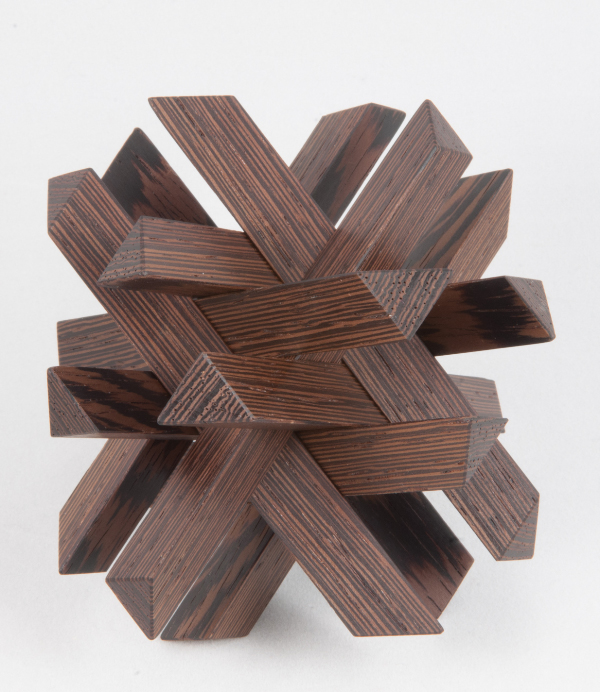
As the name says, it’s made up of three layers of sticks kept in place by magnets. Each layer can be constructed on its own, or in combination with any of the other two – each combination giving you a pretty unique looking piece.

The innermost layer provides a skeleton for the rest of the construction (although each of the other layers is self-supporting in its own right) and is made up to long triangular Wenge sticks that each affix themselves magnetically to an internal rhombic dodecahedron. Once you’ve done that you have a spikey central core that you can wrap the next layer around rather easily. The second layer uses the mid-length Burmese Rosewood sticks to lock onto the Holly blocks at each vertex – the geometry of this layer is particularly cute and it can be seen pretty clearly in the pic on the left. It sort of looks like it should want to collapse in on itself, but the magnets and the geometry do a pretty good job of making it quite stable. The final layer is the Spalted Apple that wraps around the outside. These sticks can be joined in either groups of three or four thanks to the layout of their magnets – and the overall lattice has alternating joints of three and four sticks down any path that you might care to trace. 
 
Each layer makes for a lovely looking piece – having all three together makes for a stunning piece.

I enjoyed playing around with the construction – the middle layer can be a bit disorientating to build on its own – and the simplest way to build it is probably to build the first two layers and then remove the first one from the exoskeleton. Something that also intrigued me was the discovery that if you move the Spalted Apple sticks aside a bit at any of the four-piece-joints, you uncover a perfectly rhombic dodecahedron-shaped hole that will fit one of the Holly blocks perfectly – not sure why that sort of thing still surprises me – it probably shouldn’t by now! Anyhow ... I got to playing around a little and started playing "hide the Holly blocks", and got about half – way round before the structure started letting go – remember that the Holly blocks are holding the middle layer together, so when you remove the blocks, that layer starts sliding apart as there’s nothing holding it together. You can get a pretty good feel for what it would look like – and it totally changes the look of the thing. When Jane and I were chatting about her puzzles in NYC, she mentioned that she was playing around with adding some extra magnets, and if I remember correctly, that might just enable you to place all the blocks inside the structure as I described... and keep it stable.

I was incredibly chuffed when Jane insisted that I take the Tetraxis Star Cradle as a gift because John thought they went to well together – they really do go well together ... but I was seriously embarrassed when she went rooting through the unopened box of spare puzzles submitted to the Design Competition and fished out the Chamfered Cube from that set and handed it over as another present - seriously gobsmacked!

 
 The Chamfered Cube is another multi-layered Kostick creation that starts with a tiny Chamfered Cube (...there was a clue in the name!) in the centre of four sets of three triangular sticks, with each set held together magnetically with a rhombic dodecahedron at each end. [There’s probably a picture below if you can’t wrap your mind around that – and if you can, move along, I can’t teach you anything!] The triangular Purpleheart sticks each lie flat against one of the chamfers, at an angle, leaving a tiny square pyramid of empty space against each face of the little cube. The four sets effectively form a pair of interlocking “X”s about this little Chamfered Cube in the centre, and then twelve shorter Tigerwood sticks connect each of the adjacent RD blocks, completing the structure ... which then looks like a Chamfered Cube ... in fact it looks just like the mini Chamfered Cube EXCEPT that the empty space outside the mini cube has been reversed into negative space on the square sides of the larger Chamfered Cube – neat little bit of symmetry there... :-)

Fiddling around with this puzzle also shows that you can build the exoskeleton using just the Tigerwood sticks and the corner blocks, giving you quite a funky looking zig-zag cube with a lot of space in the middle... and by the way, if you hadn’t already spotted it – take a look at the triangular grain patterns on the external corners of all of the Ash blocks on the corners of the cube ... that didn’t happen by accident.


Thanks again Jane – that was incredibly kind of you ... and I really love them!
_________________

If you’re interested in acquiring any of Jane’s pieces, please drop her an email via her web-site – each piece is pretty much made up to order so once you’ve settled on a design you can choose exactly the woods you’d like and she’ll make it up to your specifications ... oh, and she’s a wonderful person to deal with!
___________________

Neil’s written up an excellent post on all things Kostick from this year’s Design Competition (and then some!) over here – READ IT if you haven’t already...

___________________


By the way ... that little multi-coloured block just above the pen is made up of offcuts from the triangular stock during the manufacturing process - they 'just happen' to go together perfectly to make a rhombic dodecahedron. Neat!!

Friday, 7 September 2012

Tuesday – Post Post IPP Party


After breakfasting on bagels again, we took the Arcela Express to New York, enjoying the smooth ride and catching up on some puzzling along the way. In NYC we checked into The Benjamin, grabbed a bite to eat before heading to Tiffany’s in a vain attempt at redressing the spending imbalance introduced over the course of IPP, although we only shopped on the poor-people’s-floor!

That evening I toddled off to the Puzzle Party at Gossip Bar NYC, leaving Gill to some QT on her own in the hotel. It turned out I was the first to arrive, so I set myself up at the bar with a cold drink and caught my breath after the brisk walk cross-town. A short while later Viktor Genel arrived and we started chatting about puzzles and he hauled out some of his designs that had been beautifully made by Wayne Daniel. The Deschamps’ arrived and the rest of the NYC tour group arrived pretty much en-masse just after that, pretty much filling the place in a couple of minutes. Just after the arrival of the main bunch, I spotted someone who looked just like Jane Kostick and when I caught her eye and pointed at my name on my snazzy MPP polo shirt her face lit up in recognition and she came straight over.
 
A little quirk of fate resulted in us sitting at a quieter table at one end of the room, where a few others who arrived a bit later found themselves as well. I ended up having a wonderful long chat with Jane about IPP (I may have been a bit gushing!), the designs she’d entered in the competition, their development and our families. It was so nice to chat with someone who was so obviously passionate about her craft and knew her way around her designs and their geometry backwards. Quite often she’d be chatting about something else entirely while almost absent-mindedly assembling a structure almost without paying it any attention at all. Not content with assembling them one way, she’d often take them apart and produce alternative assemblies using the same pieces. 

At one point in the evening she realised she’d forgotten something and changed her earrings to a special pair that her husband John had made for her ages ago – measuring only about 10mm across, the earrings each had a set of five interlinked tetrahedra hand-crafted in gold – and only afterwards did I kick myself for not getting a better picture of her with them in place.

Jane marks herself out as a pretty awesome craftsman through her work as well as her amazing knowledge about the geometries she uses. She enjoyed telling us about some trees she’d discovered recently that grow with square and triangular growth rings on them, and then fished around in a bag of bits and came out with the pair in the pic below, one with a clear triangular set of rings and the other with a rather clear square pattern. We pretty much all called her bluff and she happily showed everyone how she’d cut the wood to achieve the patterns, adding that once you’d done the sums and realised that you needed to simply cut at thirty five and a quarter degrees to the grain, you’d be fine .... thirty five, and a quarter degrees!

During the course of the evening I’d returned her puzzles from the Design Competition to her and asked about buying one of them and was thoroughly delighted when she sold the best one of the lot to me – the 3 Layer Tetraxis Array from the competition – and a bit taken aback when she insisted that I take the bronze Emperor Star that had acted as its stand as well, “because John thought they really went beautifully together and it would be a shame to split them up”.  WOW.  I was totally bowled over when she proceeded to open the unopened spare set of puzzles from the competition and take out the Chamfered Cube from that set and give it to me as a gift, because she thought that one had the best combination of woods and was a bit disappointed that no-one had gotten to see it at the competition...

At one stage we had a wall of folks clamouring around the table playing with various bits and pieces that Jane had brought along and it was a wee bit overwhelming, but everyone wanted to play with her pieces – Jane’s work really seems to have that effect on folks.

It really was a treat getting to spend so much time with Jane chatting about her work, her craft and life in general, and meeting her friend Muli who was clearly so proud of what her college friend is doing.

Chris Morgan came over toward the end of the evening having taken his IPP Host Puzzle on a tour of the party, and told Jane all about it and then proceeded to give us a demonstration of the opening – it really was an incredibly beautiful object and the mechanism is staggering: a cut-down version of the centre-piece on Kagen Schaefer’s monumental puzzle desk, the puzzler needs to play the notes in the correct order on the organ pipes in order to release the lock – a false note and it automatically resets itself.


We all hung around chatting until Brett had to almost physically shoo us out of the restaurant about an hour after our NYC Puzzle Party was supposed to have ended.  Thanks Brett, it was a great evening from where I was sitting! And congratulations on not losing any of the ducklings! :-)


Monday Post-IPP trip to National Cryptologic Museum


Long before IPP, Wil had mentioned that he’d signed up for a trip to the National Cryptologic Museum after IPP and recommended it, so I signed up for it as well.

Knowing that it required a 9:00 am  start, Gill and I had a couple of bagels from Einstein’s in the lobby before I headed out toward Baltimore on a bus with a bunch of weary puzzlers ... even Chinny was relatively quiet on the bus, so it must have been either a very late night or jet lag had finally caught him as well.

When we got to the museum which is on the NSA campus outside Baltimore, we were split into two groups  for the tours, and as we found ourselves in the second tour-group, we hit the gift shop – de rigueur, n’est-ce pas? There were plenty of little gifts and gizmos to keep us amused for a while and even a small copy of Oskar’s Key Maze with the museum’s branding on it – I bought a handful to take home as gifts for my puzzling mates and between us I think we managed to wipe out their entire stock ... not sure if anyone on the first tour group actually even saw any of those by the time they finished their tour and got to the gift shop.

Our tour started with a few stories about some of the folks who’d been the main characters in the US Crypto community, related by our genial tour guide who still worked next door and got called across whenever they had too many tour groups for the usual volunteer staff to cope with on their own. He told us some lovely stories about the characters and their quirks and what they’d done for cryptanalysis over the years.

Next stop on the tour was a series of exhibits from around the Second World War and thereafter – and this was where our tour guide got really animated, telling us how incredible the machinery was for its time and all the secrecy around their manufacture and use at the time. He took us on a whistle-stop tour through some of the encryption devices and had some interesting stories about each one – he stopped himself at one point and explained that the technology and machinery was what got him most enthusiastic, and it really showed. (One of the guys spotted a car in the parking lot with a number plate that read SIGABA – one of the machines he’d been telling us about, and sure enough, while we were having lunch later on, he hopped in and drove off in that car.)

We moved around to an exhibit of the German crypto devices, including a pair of Enigma machines out for anyone to play with ... so we did - how many times are you going to come across an opportunity to play around with a real piece of working WWII cryptographic history.

After that we touched on the code-breaking side of things, including a brief mention of Alan Turing and the English effort on breaking the Enigma codes and then the breaking of the Japanese codes. All too soon the hour was up and we hadn’t touched several parts of the museum at all – a great trip for anyone in the neighbourhood – fascinating stories and interesting exhibits.

The museum itself didn’t have any catering, so the organisers had lined up some drinks and snacks for us to enjoy in the parking lot ... most folks sought the comfort of the aircon, but Rik and I ended up sitting on a rock at the side of the parking lot soaking up some sun ... while Rob Hegge found himself caught between the sun and the aircon, sitting in the shade in the luggage space of the bus. I had a great chat with Rik about the history of IPP (he’s been there for a lot of it!) and about the difficulties of collecting puzzles pre-internet – which still blows my mind a bit!
Where's Rob H?

After we got back from the tour, Gill and I wandered across to the mall to buy a couple of things (like a new pair of trainers – having realised my current pair were about 8 years old – although in fairness, they don’t do a lot of mileage!)
When we got back we bumped into Jen and Neil and made some rough plans to meet up for dinner before heading up to the room to start packing up all the puzzles.  Somehow Gill managed to pack everything, including the boxes I needed to take to NYC for Jane – 15 years working for an airline taught her some terrifically useful skills.

Ace tour-guide!
Dinner turned into quite an event! We’d met up with Jen and Neil and found a few others hanging around at the same time so we just kept inviting everyone along and in the end we had quite a team for dinner at King Street Blues. The four of us were joined by Rox & Kat, Dor, James & Lindsey, Rob Hegge and Scott Elliott. We had a pretty good dinner and then Wil joined us for a drink and some puzzling.  He had a bunch of matchstick puzzle challenges for us, except he didn’t have any matches, so he’d liberated some hotel pens in lieu of matches...needless to say the puzzles ended up taking up most of the table space since pens are a little longer than matches! Wil had a great time setting challenges and then telling us that our unusual approaches weren’t allowed or that there was a better...

When we eventually left the restaurant and wandered back to the hotel we must have looked a bit odd because I heard Nick explaining to someone “Oh, they’re the Renegades” as we wandered past – and I kind of liked the idea of being associated with them...

Next morning we left on the fast train to New York, with just a bit of puzzling on the train (Lonpos Cosmic Creatures)... before a puzzling dinner brought the puzzle-side of our trip to an end.