 This week’s blog post was delayed a little by a family trip
to Wales-shire… Oz was over visiting from Cape Town so Gill found us a stunning
self-catering barn 5 minutes’ walk from the beach… sounds awful doesn’t it?
Hopefully the picture will confirm just how much I was taking-for-the-team… I
did get to take some puzzles along, and there was a goodly amount of time spent
puzzling… some of which will deserve their own write-up so they’ll hardly get a
mention here.
This week’s blog post was delayed a little by a family trip
to Wales-shire… Oz was over visiting from Cape Town so Gill found us a stunning
self-catering barn 5 minutes’ walk from the beach… sounds awful doesn’t it?
Hopefully the picture will confirm just how much I was taking-for-the-team… I
did get to take some puzzles along, and there was a goodly amount of time spent
puzzling… some of which will deserve their own write-up so they’ll hardly get a
mention here.
…along those lines, the day before we left, my latest
package arrived from Wil, complete with a copy of the Butterfly Lock Box (aka Pleasure
and Pain) and Ying Yang 69 puzzles – those will definitely need to feature on
their own at some point… for now I will only say that they’re both great
puzzles – and my inherent distrust of the puzzle-meister saved me a fair amount
of pain! ;-)
Aside from the latest arrivals, I wanted to take puzzles
that would keep me puzzling for a good while, so there were a few
multi-challenge puzzles from Thinkfun for me to work through, some Minoru Abe
sliding tile puzzles and several entanglements from Dick Hess – most of which
had proved my undoing in the past… I was going to refer to them as my nemesii,
but realised there’s probably a good reason that there’s no plural for nemesis.
A couple of Osanori Yamamoto puzzles rounded out the puzzles that were successfully
solved while I was away…
 …and the quick-witted among you will realise there is at
least one obvious omission – that’s ‘cos it wasn’t solved while I was away…
hopefully you’ll also notice that I took my special £2 coin along for the obligatory
photograph!
…and the quick-witted among you will realise there is at
least one obvious omission – that’s ‘cos it wasn’t solved while I was away…
hopefully you’ll also notice that I took my special £2 coin along for the obligatory
photograph!
The lengths I go to…
Two Thinkfun multi-challenge puzzles helped keep me puzzling
for several hours on the Gower:
Turnstile
provides 40 graded challenges (the earlier ones just really get you used to the
mechanics of the game) where you’re given a start positions with gates and
pieces set up in a particular fashion. Your challenge is to move the coloured
counters to their home corners while negotiating the turnstiles and the other
pieces (the grey pieces are basically just movable road blocks). Good fun to take out and work through a few
challenges at a time before switching across to another puzzle… the latter
challenges will definitely give you something to think about, but remain
accessible.
Tilt provides a
great real-world implementation of gravity mazes that seem to pop up in puzzle apps
quite regularly. The challenge cards show you where to place blocking pieces and
green and blue counters. Your job is to tilt the board successively in
different directions so that the green counters fall through the hole in the centre
and the blues all remain on the board… and the only rule you need to worry
about is that you must let all pieces slide and come to a rest against
something (i.e. no sneaky half-moves – that’s cheating!). Having played one or
two of these apps definitely helps a bit, but the later challenges have a
number of traps for the unwary (yes, I was very unwary!) – but resetting and
starting over only takes a few seconds and you’re ready to go with a clean
board. Nice real world application of this sort of puzzle – with the mechanics
working pretty much all the time, but if anything does get caught, a tap or two
will send them on their way.
A couple of weeks ago I’d picked up three Osanori Yamamoto
burrs from Satomi at CU-Japan. These weren’t particularly expensive as they’re
made from thin laser-cut MDF. While nothing beats a lovely exotic wooden
version, until someone takes up the challenge of making them, these
represent a great cost-effective way of getting the designs out into the
market.
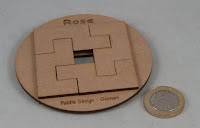 Rose presents you
with four interlocking pieces trapped in a central circular frame. Your first
job is the find what movements are possible, and with a new puzzle, the pieces
need to be well-aligned or you won’t find anything moving. Find some movement
and if you’re like me, you’ll find yourself going round and round in circles…
you need to be a little more subtle than I generally am to find the next set of
moves – and given the designer, you’ll be tempted to start exploring all manner
of rotational moves as well… good luck with that!
Rose presents you
with four interlocking pieces trapped in a central circular frame. Your first
job is the find what movements are possible, and with a new puzzle, the pieces
need to be well-aligned or you won’t find anything moving. Find some movement
and if you’re like me, you’ll find yourself going round and round in circles…
you need to be a little more subtle than I generally am to find the next set of
moves – and given the designer, you’ll be tempted to start exploring all manner
of rotational moves as well… good luck with that!
 Rose 2 is a
development of Rose, with a more complicated frame and some differences in the
pieces… you probably want to play with Rose before going on to Rose 2 if you
want to maximise your enjoyment on these two… another lovely little design that
will amuse the most-hardened puzzlist. (Oh and it take 26 moves to release the first piece!)
Rose 2 is a
development of Rose, with a more complicated frame and some differences in the
pieces… you probably want to play with Rose before going on to Rose 2 if you
want to maximise your enjoyment on these two… another lovely little design that
will amuse the most-hardened puzzlist. (Oh and it take 26 moves to release the first piece!)
 # Shield gives
you a frame with four pieces that need to make up a “#” sign inside the frame,
only this time there’s a ledge along the bottom that will block quite a few
rather useful moves… which makes it a rather nice challenge.
# Shield gives
you a frame with four pieces that need to make up a “#” sign inside the frame,
only this time there’s a ledge along the bottom that will block quite a few
rather useful moves… which makes it a rather nice challenge.
A pair of sliding tile puzzles from Minoru Abe kept me quiet
for quite a while. Angel and Satan
has two simple little creatures, each made up of three pieces that need to be
transposed – that’s all! There’s a huge gap in the centre between the two
figures and only a tiny little interfering piece in the centre. Yet it’s thoroughly
non-trivial! I’d had several bashes at it before my holiday and got nowhere, so
I was delighted when I finally managed to work out how to make use of every
little feature in the design to get those two creatures to swap places… I think
the optimal solution requires 74 moves… I took somewhat more!
 Runaway II
provides a 5 different challenges with varying themes on moving a set of digits
from 1 to 4 from the top to the bottom (or vice versa) via two different sized cut-outs
between the two rows… Oh, and there are a pair of stars and a heart to get in
the way and force you to think a few moves ahead… which I’m rubbish at!
Runaway II
provides a 5 different challenges with varying themes on moving a set of digits
from 1 to 4 from the top to the bottom (or vice versa) via two different sized cut-outs
between the two rows… Oh, and there are a pair of stars and a heart to get in
the way and force you to think a few moves ahead… which I’m rubbish at!
Finally, in preparation for an upcoming visit form the
entangle-meister himself, I took a few sets of Dick Hess’ entanglements along …
mainly because I’m thoroughly rubbish at them and haven’t been able to solve
any of them yet and I wanted to avoid the embarrassment of having to admit I
couldn’t solve any of his puzzles at all…
First off the Mini-Menagerie Puzzles – Dick’s IPP26 exchange
puzzle. This set consists of the Ox, Rhino and Whale and to the neophyte, they
all look like they’re more or less the same puzzle… yet I hadn’t managed to
solve them yet despite the odd attempt at doing exactly that!
To the untrained eye, the Whale looks to be the simplest… so
I started there, and promptly got nowhere – it doesn’t have a lot of the complications
that the other animals have, yet I just couldn’t get it to do what I wanted… so
I switched to one of the land-based animals and had a little more luck, after
quite a while I found I could get the Ox’s bits to do something interesting
that I hadn’t expected, and pretty soon I had removed its tail (or rider, of
you prefer).
Flushed with a sense of victory I switched attention to the Rhino
and tried something similar – only to find that simply wouldn’t work… so I spent a long
time experimenting before I finally found something (else) totally unexpected …and
had its tail off too. The Whale finally succumbed too, but only after I’d
generated a HUGE amount of respect for my friend Dick – he’s made those puzzles
all look thoroughly similar, but are they? Heck! That was a lot of fun, and I’m now looking
forward to trying my inexperienced hand at some more of his puzzles – if they
give me half as much of an A-Ha! moment I’m going to be very chuffed!
The final two puzzles in the pics are a pair of Dick’s Sisters
– from his IPP29 exchange puzzle Three Sisters – spot the missing one yet? Sadly
I only managed to take two of the sisters apart – the Tall Sister still eludes
me…
These puzzles again look totally similar yet the subtle differences in the
shapes or the design of the rings makes their solutions totally different –
Blonde and Dancing Sister yielded after a good session of experimenting where
the solution always looks like it’s not too far off – you’re pretty sure you
know where you’re trying to get things, they just won’t quite go where you want
them… a couple of little bits of wire kept me wonderfully amused for hours…
thanks Dick!

 About a
week later a parcel arrived with a lot of Greek stamps on it and I knew
I was going to enjoy this.
About a
week later a parcel arrived with a lot of Greek stamps on it and I knew
I was going to enjoy this.  Should be simple… but there is one small wrinkle: the two “Z” s are joined
together into a single (double!) tile – and as a result it can’t move up into
any of those passing places.
Should be simple… but there is one small wrinkle: the two “Z” s are joined
together into a single (double!) tile – and as a result it can’t move up into
any of those passing places. Should be simple… but there is one small wrinkle: the two “Z” s are joined
together into a single (double!) tile – and as a result it can’t move up into
any of those passing places.
Should be simple… but there is one small wrinkle: the two “Z” s are joined
together into a single (double!) tile – and as a result it can’t move up into
any of those passing places. For a
five-piece sliding block puzzle it has a surprising number of required moves –
Mike reckons somewhere around 30 – and I’m sure he’s right, although I don’t
think I’ve got it anywhere near as low as that! I find myself thrashing around
trying the same things over and over again, before pausing to Think(c).
For a
five-piece sliding block puzzle it has a surprising number of required moves –
Mike reckons somewhere around 30 – and I’m sure he’s right, although I don’t
think I’ve got it anywhere near as low as that! I find myself thrashing around
trying the same things over and over again, before pausing to Think(c).  It’s a
lovely little sucker-punch of a puzzle that looks really simple, but isn’t… and
the sheer beauty of the thing draws you in and makes you want to play with it.
It’s a
lovely little sucker-punch of a puzzle that looks really simple, but isn’t… and
the sheer beauty of the thing draws you in and makes you want to play with it. 


