Saturday, 16 November 2013

Binary and Ternary Burrs


I’ve been wanting to get my hands on a Binary and a Ternary Burr for absolute ages, so when Eric Fuller hinted that he might be making some and teasingly asked if anyone might be interested, I sat up and paid close attention. 


A short while later he announced that the Binary Burrs were available and I piled in … and then did the same again when the Ternary Burrs were ready a little while later. 


The Binary Burr was designed by Burr-Master Bill Cutler back in 2003 when he entered it in the IPP Design Competition and promptly won first prize for his trouble… this puzzle has pedigree! Bill has taken the Classic Chinese Rings concept and burr-ified it – giving you a slider that interferes with a two sets of ring-pieces set at ninety degrees to one another. The ring-pieces move in and out (a bit like pistons in an engine) according to certain fairly simple rules and a whole heap of recursion. Those bits are all kept in place by a clever interlocking 14-piece cage that only comes apart when the slider and the ring-pieces are removed. Removing the slider (the first piece to come out) takes 85 moves … <GRIN> 


Jerry McFarland has produced a number of copies over the years but I hadn’t managed to snag myself one of them, so Eric’s run was great news. 


Eric’s version uses cherry for the cage and walnut for the slider bar and ring-pieces.  He’d had a bit of trouble keeping the humidity in his workshop stable while he was producing the Binary Burrs so they ended up a bit looser than he would have preferred. (The cumulative tolerance was off by a miserable 0.035”!)  In the end he offered them for sale at a silly cheap price and they disappeared even quicker than his usual batches of puzzles would. 


It absolutely looks the business, even if the fit isn’t up to Eric’s usual impeccable standards … you do need to make sure that the pieces are all properly aligned before you can make the next move and in some of the positions you need to make sure that the wrong pieces don’t accidentally drop down when you don’t want them to… but I now have a super-looking copy of one of the classic modern puzzle designs in my collection – and I won’t be letting this one go any time soon. 


Ternary Burr was the result of Goh Pit Khiam’s fantastically creative mind wondering whether it might be possible to adapt Cutler’s Binary Burr in the same sort of way that Markus Goetz had adapted Spin-Out from the binary puzzle to his ternary version in the Crazy Elephant Dance.


Ternary Burr uses the same basic design as the Binary Burr and then modifies the ring-pieces so that they have three positions instead of just two, with each ring-piece’s permissible movements being determined by the positions of the pieces before it. The Ternary Burr was originally produced as a Limited Edition of 30 by Brian Young in 2009. So while getting hold of a copy of Binary Burr was hard, finding a Ternary Burr was pretty much impossible until Eric produced his latest batch … and he got the tolerances absolutely perfect on these!


Once again Eric’s used cherry and walnut, so the Ternary Burr looks stunning next to its baby brother Binary Burr. There is absolutely no unwanted slop in this puzzle – everything lines up beautifully all the time and the mechanism is an absolute joy to fiddle with. Even though the Ternary Burr only has four ring-pieces, it still takes 75 moves to remove the first piece, with the ring-pieces and the cage then coming apart in pretty much the same fashion as the Binary Burr. 


This one became one of my favourite burrs almost immediately and I’d struggle to imagine something unseating it. 


Since Eric’s round of Binary Burrs made their appearance my friend Steve has been playing around with a 3D printed version of this puzzle, and then went on to tweak things a little by adding some extra ring-pieces and has now produced an eight and a twelve ring version! (Jolly thousands of moves!)


Steve’s bonkers! 


The world needs more Steves! [Well done mate – fantastic project!] 


…and if you’re interested in these sort of n-ary puzzles, you really should bookmark Goetz Schwandtner’s compendium pages over here and his n-ary puzzle page over here.


Saturday, 9 November 2013

A pair of Jack’s


[Let’s see how many poker searches pick this one up!] 


Back at DCD a couple of weeks ago I picked up a lovely pair of Jack Krijnen’s little masterpieces.


Elevenses II reminded me a little of one of Bill Cutler’s Wausau series of burrs in that it has different numbers of pieces in each axis so it looks a bit out of the ordinary right from the start. This one’s a 2*3*4 burr and Jack has rather helpfully picked three different coloured woods (walnut, padauk and bubinga –I think bilinga - Thanks for correcting me, Jack!), for the three axes – which makes trying to work out where the pieces might need to go, a whole lot easier! 


Easier, but certainly not simple! 


Taking it apart is reasonably straight-forward, albeit quite interesting! The first move is a bit unusual and then you find yourself in a series of moves as each move allows successively more and more movement until the first piece is released at move 9 … letting you see Jack’s signature inside the remaining structure –neat touch! :-)


Reassembly is far more of a challenge (ain’t that always the case with burrs?)! Using the colours you can work out where in the final structure the various bits need to be, and remembering that it took you 9 moves to release the first piece you know that you’re going to need to do quite a bit of manipulation before you can insert the last piece … at least it’s a reasonable challenge for relative burr-neophytes like myself… Jack may well have other views!
 

[The first Elevenses had the same shape (2*3*4) and required 11 moves to release the first piece, but had 4 solutions… this version has a unique level 9 solution, but retains the name, but I reckon it makes a good tea-time puzzle!] 


Framed! caught my eye as soon as I saw it – it is gorgeous: an 18-piece padauk burr captured in a zebrano frame. It’s one of Jack’s relatively recent designs (2013) and it packs a serious sucker punch!


It’s “only” a level 3 burr – you move two pieces on two of the axes in order to release a third piece on the remaining axis … and then the two pieces you’ve already moved come out successively. “Simples!” to quote a meerkat. 


So five moves in and you’ve removed 3 pieces already … well, it turns out you’ve just released a sort of 3-axis key piece … and now it gets interesting… from there you need another 11 moves to get the next piece out, and in spite of having a fair amount of space to play with (having already removed three pieces!) you’ll find that the pieces cannot be coaxed out until the right combination of moves has been completed. And that series of moves has pieces moving around all over the show and you may well find yourself inadvertently allowing a piece to move past where you actually wanted it to be, blocking any further progress… 
 

This one starts out being nice and friendly and then turns into a bit of a monster – a real Jekyll and Hyde burr…


Reassembly? If you’re an amateur like me you’re going to find it tricky enough just trying to get it back together using Burr Tools – I cannot imagine trying to do it without… I’ll leave that to the experts out there… you know who you are…


Sunday, 3 November 2013

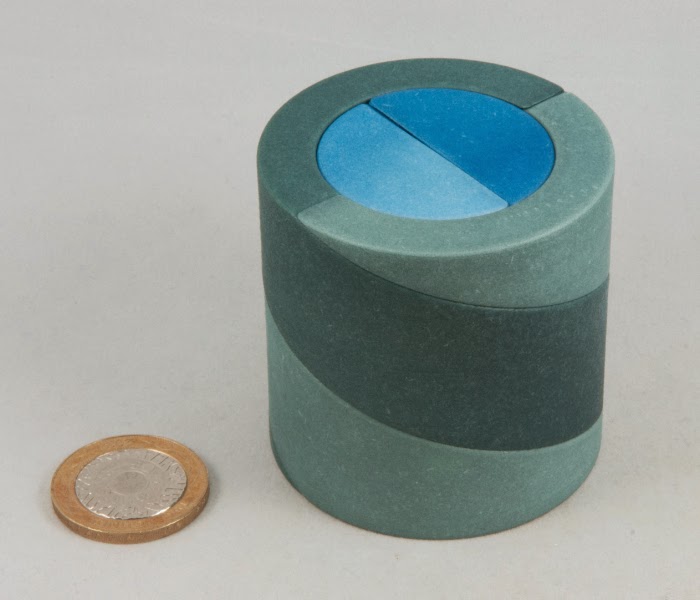
Helical Burr


If you’ve been following this year’s puzzle news you must have spotted that Derek Bosch won the prestigious Jury Grand Prize at this year’s Nob Yoshigahara Puzzle Design Competition with his Helical Burr. 

I’d heard some rumours of something interesting in the works and then seen a late prototype at one of our puzzle gatherings and it drew quite a few admiring comments from those who had a play with it…I didn’t get to spend much time on it before it headed up to its new owner, but it’s cylindrical shapes definitely sets it apart in burr-world. 

A while later in Japan I had a bit of a play with the copy in the Design Competition, but as luck would have it, someone before me had left it in bits, so I had a half-hearted attempt at putting it back together again and failed miserably so I quickly moved along to something simpler in order to restore my sense of self-worth!

At the end of IPP, sitting with a bunch of Renegades there was a really loud cheer when Derek’s design was announced as the Grand Prize Winner at the awards dinner – one of “our guys” (not sure why they let me associate with them!) had won one of the big prizes, again! Cue all manner of celebrations that could only have been a little bigger had Derek actually been in the room at the time.

Back home a little while after IPP and Derek let us know that he was going to make up a few and was taking orders, so Gill decided to get me one for my birthday, and unbeknown to her at the time, I snuck in an order for one of Derek’s Rhombic Maze Burrs as well, but that’s a whole other blog entry…

When I received my copy I hadn’t really had much of a chance to play with one yet, so I was really starting from scratch as it were. The puzzle is 3D printed by Shapeways and dyed by Derek. It consists of 4 different coloured pieces that make up an inner core of two interlocking pieces and an outer frame. You can see from the outside that the frame will unscrew into two pieces, and your first temptation may well be to try and unscrew them… 

When I started playing with the burr, my first thought was that it was rather stiff and the pieces were very tight… so I kept at it and hoped that it would loosen up with a little playing, but I wasn’t getting much movement at all. I started paying more careful attention to the way that I was gripping the pieces to make sure that I wasn’t blocking my movements, and that helped a little, unscrewing the outer case a little, but then, nothing…

Realising that trying the same things over and over again weren’t yielding any more useful results (I’m sure there’s a quotation about that somewhere!) I switched tack and tried something else. And all of a sudden, I had movement of a different and rather unexpected type. Finding the next move didn’t take quite as long as the first, and from there on progress was a bit better, until, at around 11 moves the first piece is removed.

Separating the pieces helps you understand why the pieces behave the way they do, with strange-shaped protuberances inside the frame pieces to both obstruct the inner pieces and force them to turn in a particular direction… quite ingenious and how the heck Derek designed it, I have no idea! 

I find playing with it a lot of fun and have found myself going through the movements of opening and closing it stacks of times because it’s fun to fiddle with! There’s a lovely little bit of puzzle choreography at play as the four pieces interact in a series of movements that take it from a compact cylinder to an extended, open structure with all its innards on display – just before it releases the first piece and the rest come apart pretty simply. 

Definitely a puzzle with plenty of repeat playability – and it’s a pretty cheap form of therapy!

Great design Derek, and a worthy winner!  Well done mate!