Showing posts with label Alfons Eyckmans. Show all posts

Saturday, 30 March 2013

Vectes / Ghidorah Box


The last of my writes-up on Eric Fuller’s latest offering is an unusual pair of caged burrs. They were designed by different people at about the same time and they share a common cage – so Eric has produced them as a set with a single cage and two pairs of burr pieces.


The common bit, the cage, is made of walnut and uses some nifty shouldered joints to make sure that enthusiastic puzzlers aren’t left holding a pile of pieces when trying to extract those three little burr pieces.


It’s a simple 6*6*6 cage with an outer ring on each side and a 2*2 hole in the centre. Then there are four interfering cubes in the middle layer of each face that are either offset clockwise or anti-clockwise around the face in such a way that opposite sides coincide ... a few designers (not just these two!) have employed frames this shape in their devious pursuits.


Ghidorah Box was designed by Yavuz Demirhan in 2012 and has three dissimilar pieces that Eric has made in canarywood. Eric billed the Ghidorah Box as the warm-up of the two puzzles inasmuch as it has “only” a level 22 solution – although I reckon it’s still a pretty decent challenge. There are only so many ways that you can put the three pieces together in an interlocking form, and then it’s just a case of working out how to get them in that target shape inside the frame from hell! I tend to think of working in terms of degrees of freedom – get as much freedom as you can with the pieces in situ so that you can introduce the last piece and then work them together into the target shape ... sometimes it works!


Vectes designed by Alfons Eyckmans uses burr pieces that are two units longer than the frame, so they end up sticking out either end, and generally getting even more in the way during solving. These pieces have been cut from some lovely yellowheart and also fit perfectly in the frame. A couple of the moves in this solution involve some pretty precise positioning of the pieces and it’s pretty clear that Eric has got the fit spot on – get them properly aligned and they move perfectly, have one of the burrs a little off line and it will refuse to slide home... the bevelling on the ends does help with that a little.


Vectes is the definitely daddy here at level 37 moves to free the first piece and that translates into more manoeuvring to get some of the bits in a useful space to move the other bits around... lovely puzzles that work really neatly as a pair.


WELL DONE Eric for spotting the common thread and for producing a pair that go together beautifully.


Afterthought: as I was writing up this post my mind went wandering a little and I wondered if it would be possible to mix and match the pieces a bit ... and indeed it is! Franken-puzzle anyone?


Wednesday, 14 December 2011

Nemesis: Monster Packing Puzzles and Big Burrs

Recently I’ve bought a few puzzles that I never expect to solve. 
Weirdo!
That’s probably fair, but hear me out…
The first one is a packing puzzle that came from a recent auction – it’s a copy of Parcel Post made by John Devost in June 2008. It was sitting there looking rather unloved with nobody bidding on it, so I bought it. It’s a really beautiful piece of work – the pieces are made from walnut and the tray is made in padauk with maple slipfeathers. The tolerances between the pieces when they’re packed in the tray properly are incredibly fine – there is virtually no wiggle room at all, yet the pieces literally just drop into place – perfect!
The Parcel Post design has been around for ages (one source quotes “early 1900’s”), although the mists of time appear to have obscured the original designer’s name. The puzzle contains eighteen rectangular pieces to be placed inside a shallow tray. Pretty soon after you start playing with this puzzle, you’ll work out that there will be three layers of pieces in the solution, but that unless some of the pieces are arranged vertically across layers, you’re not going to get very far … and that little twist makes this an absolute killer puzzle in my books. I’ve spent a fair amount of time fiddling around with it and it has beaten me every time. There are too many pieces that could fit vertically and too many ways of almost making up three layers of bits with suitable gaps in them for the vertical pieces – I’m satisfied that I’m beaten, but it looks great in the collection, so it’s going to stay.

So that’s my first nemesis… (By the way, what is the plural of nemesis?) 

The other two puzzles that are likely to defeat me forever are fairly recent acquisitions. They are Big Burrs by literally any definition – first off, they are eighteen-piece burrs, the smaller of the two has pieces that are 12 centimetres long and the larger’s pieces are 15 centimetres in length. They’re called Tiros and Lange Wapper 14 respectively – both creations of Alfons Eyckmans’ fertile mind – although these are both variants of the original design with variations added by Guillaume Largounez to eliminate the alternative assemblies. The puzzles were made by Maurice Vigouroux and they came via a slightly circuitous route via Guillaume through my puzzling mate Chris – the Puzzle-Place guy. They are pretty unique as these burrs aren’t often manufactured (they present a couple of manufacturing challenges like blind corners and weak elbows that a lot of folks might avoid – but Maurice handles them with apparent ease – and some hand-chiselling and dowel reinforcement if you’re interested). They’re beautifully finished, including some decorative finishing around the edges of the pieces so that when properly assembled, the bevelling matches – and provides a unique solution – nice touch Guillaume! Take a look at Chris’ ‘special’ copy over here – it is simply gorgeous! 
The ‘easier’ of the two, Lange Wapper 14 was shipped disassembled as an assembly challenge – chance would be a fine thing! The complete solution requires 70 moves – removing the first piece from a completed burr takes 14 moves, and the next two pieces take another 21 and 15 moves respectively – now can you see why I think it’s a monster?! “Assembly challenge” may be a little bit of an understatement!
Tiros
Tiros, mercifully was shipped assembled (and it may well stay largely that way forever! – Nah, at some point I’m going to take it apart just so that I can say I have!). This particular monster requires 150 (!!) moves to release the first piece(!) and I think it currently holds the record for burr level on a standard 18-piece burr – a further 36 moves dispatch the remaining pieces to a pile on the desk.
These burrs are lovely, and given their pedigree, I’m very chuffed to have been able to add them to the pile o’ puzzles I try hard not to call a “collection”. But do I stand a hope in heck in of ever working out how to take them apart and put them together again (without the use of Master Röver’s software) – I very much doubt it …
So there you are, three of my current nemeses, or nemesi if you prefer, to answer my own question…

Saturday, 24 September 2011

Cubic Dissections action


There are a few websites that I like to keep an eye on fairly regularly just in case something interesting comes up – Cubic Dissections is one of them. A couple of weeks back I happened to notice some really weird things happening to some of the listings – they seemed to be multiplying and moving around on the web page, then they started changing, but they all seemed to be referring to items that were sold out. 

The next day the movements seemed to begin to take shape and settle down and shortly after that I received Eric’s traditional email warning that some new stuff had been added to the web site for anyone that was interested.

Now last time that happened a couple of months back, the warning email arrived just after I’d turned off the netbook for the night and by the time I logged on the next morning, a couple of the really interesting items had already all been sold out – dagnabbit!

I did get a few really nice items anyway, and managed to pick up a copy of Three Sticks Trapped when Oli decided to get rid of a couple of the items he’d managed to buy, so it wasn’t a total loss by any means – just in case you’re beginning to feel the need to be sympathetic!

This time around, things were different – I piled in straight away and managed to get everything that I wanted – and Eric’s usual efficiency and the fact that the parcel came straight to my front door (instead of spending a week or so in customs first!) meant that I had my new toys pretty soon afterwards – and in good time for the next MPP where a few of them got passed around among some of the folks who hadn’t managed to pile in quite as quickly as I had. 

Here are the highlights: 

Stand Py Me was designed by Gregory Benedetti and published earlier this year. It was added to Ishino’s website in May this year and 4 short months later(!) there was a discussion about it on Renegades, with Gregory explaining the name was a play on words around a “Py-ramid on a Stand” – with the basic internal structure resembling those pesky offset cube puzzles like Coffin’s rather famous three-piece block puzzle. 

Stand Py Me starts with a four-piece offset cube structure in the shape of a tetrahedron – but adds a twist by insisting that it should be built in a frame that captures three sides of the pyramid. 

Now Gregory is rather well-known for his puzzles having a bit of a twist to them – in fact his Youtube channel name is “Rotations Required” ... so when I attacked this puzzle, I had that foremost in my mind and subsequently spent several fruitless sessions trying to engineer a means of partially assembling the pyramid in situ and then twisting the last pieces into place. After trying that approach for quite a while, I wondered out loud if there might be a simpler, purer, better way of doing things –the dogs gave me a very strange look at this point. From there it honestly didn’t take long to find the right, rather elegant solution that allows everything to slide perfectly into place out of position and then slide into the final positions required to make the pyramid. 

Eric has made these puzzles beautifully - his attention to the details is staggering: just take a look at the joints on those frames! And his kindly using a contrasting wood for the extremities definitely helps numpties like me solve the thing. 

Neil’s already shared his thoughts on this puzzle in his blog and you can read them over here.

Two Pi is another Gregory Benedetti design from 2009.

This one is a three-piece cube that Eric’s made out of Zebrawood. 

It’s a reasonably straight-forward co-ordinated motion puzzle with the shapes of the pieces designed to have you pulling against yourself for all of the usual means of gripping a cube. There’s another interesting little feature of the design that from some angles, it looks like a simple 3*3*3 cube, but from other angles there are clearly some rather odd diagonals. The coolest thing about the cube is that playing with it and trying to tug it apart using any natural feeling grip will give the impression of a totally unyielding cube – yet in the right orientation, a simple spin on a flat surface will send the pieces flying apart. [Don’t do that near the edge of a desk like I did, or one of the pieces may well end up on the floor in more bits than desired – it’s back together again, but it doesn’t fly apart quite as slickly as after Eric had put it together the first time!] 

Eric made up a beautiful version of Martin Watson’s Digigrams. Martin tells the story on his website about coming up with the idea for the puzzle one night when he couldn’t sleep and found himself watching his digital alarm clock tick over. Since then it’s been made in several formats and sizes (e..g take a Look at Steve Strickland’s version over here) and served as an IPP exchange puzzle in Tokyo in 2001. 

The premise is simple: arrange the digits 0-9 inside the 4*5 tray.

Deceptively simple.

Devilishly difficult.

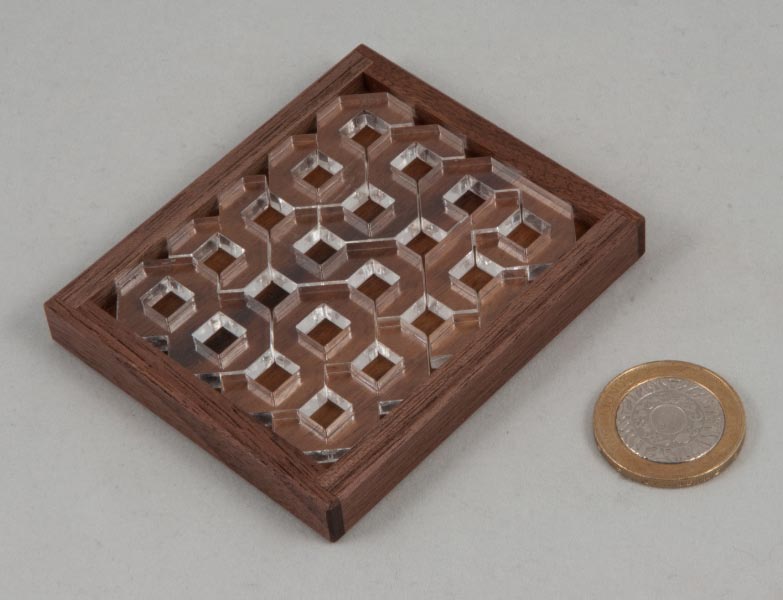
Eric’s version uses clear laser-cut acrylic digits and they look terrific against the grandillo base of the tray.

You can read Jerry’s thoughts on this puzzle over here.

Galaxy by Osanori Yamamoto was one of the puzzles that I missed out on in the last round at Cubic Dissection so I was delighted to find that a couple more had been put up for sale in this round. Four identical burrs need to be inserted into a frame – and the clue to the complexity of this fiendish little puzzle is summed up in the fact that it’s a level 18.10 burr – so that’s 18 moves to release the first piece, and then another 10 moves before all three of the remaining bits come flying out, together. 
 
It goes without saying that Eric’s work is great on this puzzle as well – one little thing to be aware of is that because the puzzle has so much air in the middle, some of the pieces will want to lean over and that will impede progress – best to keep your bits upright. 


Havanna’s 2 by Alfons Eyckmans is a lovely four-burrs-in-a-box puzzle. Eric has made the burrs in purpleheart wood and it looks brilliant in the walnut box. This one’s pretty tricky and removing the first piece takes an awful lot of manoeuvring of all the bits in the box. 

The first time you try and take the puzzle apart, your immediate challenge is trying to work out where the stoppers inside the box are and more or less what shape the pieces are – and having removed them, realising that the pieces are somewhat more complex than I thought they were. 
 
Several far more eloquent writers have already blogged about the Zauberflöte. Neil raised some interesting questions about ‘solutions’ on Renegades using this puzzle as an example – specifically, if rotations are clearly possible on a puzzle design, should they be allowed in a solution – and it was quite interesting to hear from Gregory “Rotations Required” Benedetti who designed this puzzle, that as far as he was concerned, even if a puzzle wasn’t designed to use rotations (and this one hadn’t) if they were clearly possible and they resulted in a shorter solution, then absolutely they should be used and explored! 
 
You can read Neil’s take on the puzzle over here. Puzzle-solver extraordinaire Brian Pletcher has written about it over here and the professional number (think about it!), Kevin, has written about it over here.

All I’d add to their expert opinions is another vote for this format of clear acrylic boards combined with lovely hardwood bits – it looks great next to Eric’s Padaung Rings!