
I feel very guilty about not
writing about this box yet… I’ve had it for months, played with, solved it,
enjoyed it, but not yet blogged about it… I am sorry.
Let me rectify that now…
Just before I left sunny UK for
a cruise up Alaska and a trip to Canada, with some puzzling thrown in for good
measure, I received an email from Robert Yarger offering me a copy of his latest
Puzzlebox – a collaboration with William Waite. You’ll know me well enough by
now to know that I don’t turn down invitations like that, so I winged some
Paypal across to Rob and then had to do something really hard: I asked him not
to sip it for three weeks so that there would be no chance of the package
rocking up while I was out of the country enjoying beavertails.
 Rob duly shipped it over just
after I got back from IPP35 and it didn’t take long to arrive.
Rob duly shipped it over just
after I got back from IPP35 and it didn’t take long to arrive.
Quite a few of Rob’s previous
puzzlebox designs have incorporated a nod to another genus of puzzle, like his
Lighthouse incorporating elements from Hoffmann threaded puzzles, kumiki
puzzles in The Little Game Hunter, automata in his Checkmate Box and sliding
tile puzzles in the aptly-named Sliding Tile Box.
The Edelweiss Puzzlebox
incorporates a neat tray-packing puzzle designed by William Waite to provide
the locking mechanism. At the start of the puzzle you have the pieces neatly
packed in their place on one side of the box… with the box very securely
locked. On the opposite side there are some similarly shaped bits forming a
trivial tray-packing puzzle – unfortunately those bits won’t unlock the puzzle!
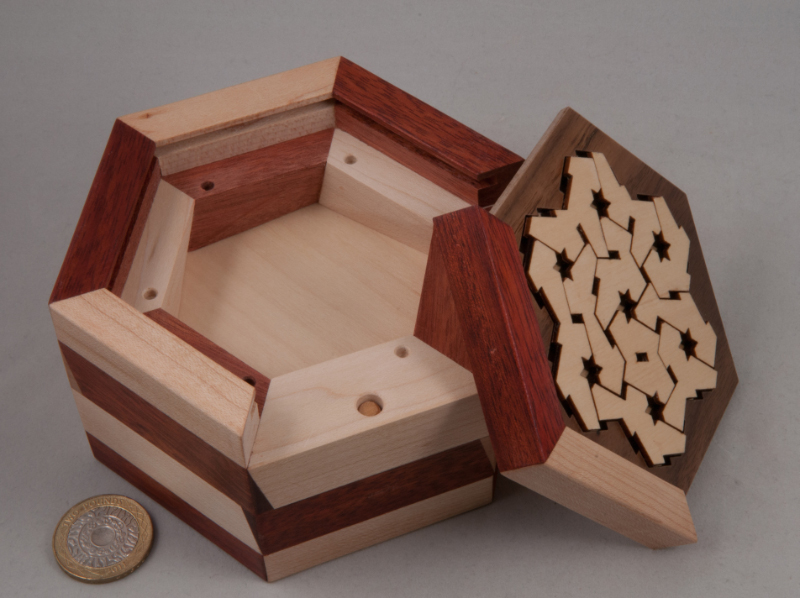 Your goal now is to pack the
first set of pieces into the two trays, one on either side of the box – get it
right and you’ll release one side of the box and gain access to its secret
compartment… as long as you open them in the right order – else you get nowhere
at all!
Your goal now is to pack the
first set of pieces into the two trays, one on either side of the box – get it
right and you’ll release one side of the box and gain access to its secret
compartment… as long as you open them in the right order – else you get nowhere
at all!
Find the right assembly and
you’re presented with either a patchwork of little Swiss flowers (hence the
puzzle’s name) or a blanket of snowflakes – slot them into place in the
appropriate tray and you’ll hear a set of satisfying little clicks as the
magnetic locks all slide into place and allow their compartment to open.
 Open it all up and you have to
admire the elegance of the implementation of this locking mechanism – the tray
packing puzzle needs to be properly solved and the two trays need to be solved
in the right order – and the mechanics behind enforcing those rules is wonderfully
simple - a really clever design.
Open it all up and you have to
admire the elegance of the implementation of this locking mechanism – the tray
packing puzzle needs to be properly solved and the two trays need to be solved
in the right order – and the mechanics behind enforcing those rules is wonderfully
simple - a really clever design.
My favourite thing about the
Edelweiss Puzzlebox? It arrives in a solved position but you’re forced to
scramble it and re-solve it before you can open the first compartment! … and
opening the second compartment can be done with a flourish if you’re so
inclined.


