Showing posts with label George Bell. Show all posts

Sunday, 7 March 2021

Triple Chocolate Box

George Bell has a knack for designing mean puzzles that mess with my head – admittedly I’m setting a low bar here – but I suspect that his love of playing with spheres and truncated octahedra manage to confuse some others as well.

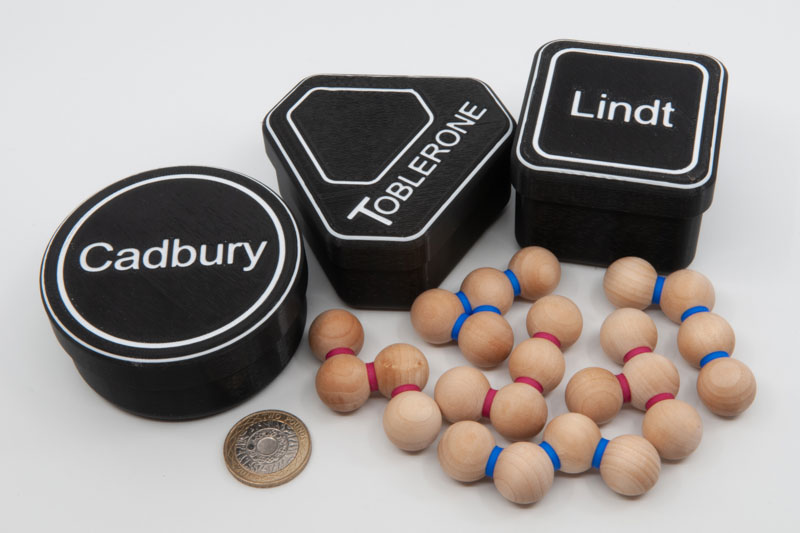
My latest puzzle from George’s Etsy shop was Triple Chocolate Box – his entry in the 2020 Nob Yoshigahara Puzzle Design competition. This puzzle makes great use of George’s new 3D printer to produce the three black and white boxes adorned with your favourite brands of chocolate. Your task is to pack the 24 little (slightly wooden) chocolates into each of the three boxes in turn, so that their lids are fully closed. Of course George has helpfully joined those 24 little balls into six sets of differently shaped pieces, just so you aren’t bored to death by a trivial packing task.

Clearly the boxes presented provide a basic round, triangular and square shape for the packing, but the boxes are all slightly different heights… which is interesting.

When the puzzle arrived, the pieces were all snugly inside the Lindt box, and George’s helpful note suggested tipping the pieces out blindly before playing – and that’s great advice, but let me assure you, gentle puzzler, that even if you catch a view of the pieces as they come tumbling out, it will help you not a jot, because they do tumble rather chaotically and then lie there on your desk mocking you, of perhaps that was just me.
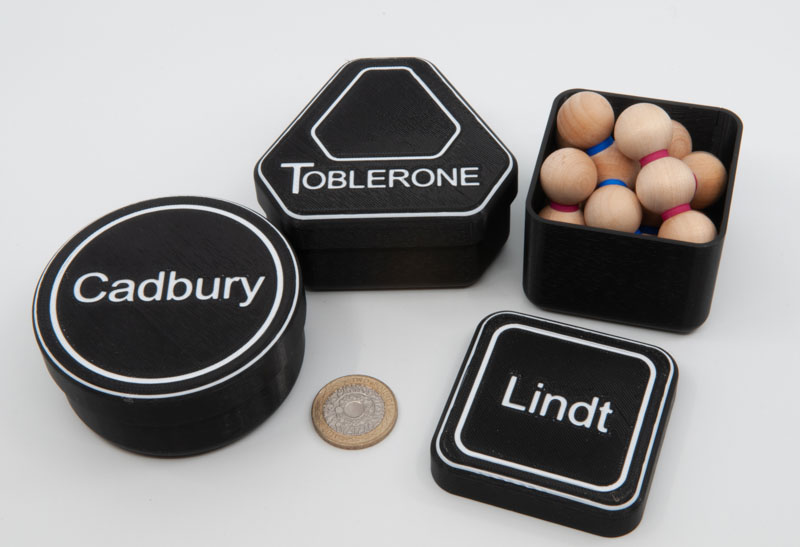
I started off with the round box and it took quite a while of fiddling and experimenting for me find some almost-solutions – and then some more experimentation to find an actual solution – and by now I’d found that I’d started getting the hang of how the different shapes interacted among layers of the packing and I actually felt like I was beginning to understand things with the first one solved…

…which is probably exactly what George was hoping, because when I moved on to the triangular box, I found that most of what I thought I knew, was pretty useless. Try as I might to get things to work in the second box, they wouldn’t… until I literally went right back to basics – and that really helped. So I built up a while new model of “how things worked” and managed to squeeze them all into the second box.

At this point I’m probably feeling a little smug and I dive into our old friend the Lindt box… after all, I’ve got two different packing schemas available to me so it’s just a case of finding the best one for the job and bashing through it…

Of course George strikes again – and soon enough you realise that neither of those is any use at all… so you head back to the drawing board yet again… the final box is pretty mean and the first two do a great job of gently leading you up the garden path before the third one positively crushes you. You’ll need what you learned on the first two, but you’ll need to find an altogether different approach, yet again.

It does provide an excellent sense of satisfaction when you finally find The Third Way and you can drop that final little piece neatly into place… what I love most about this puzzle is the fact that George’s three boxes force you into totally different ways of packing those little spheres together – each of them seemingly pretty compact, and all of them recycling the same set of pieces. 

It’s a great set of packing puzzles.

Sunday, 10 May 2015

Balls from Fuller


[...because "Truncated Rhombic Dodecahedra puzzles from Eric Fuller" didn't have quite the same ring to it...]

Eric Fuller’s been playing with some of Stewart Coffin’s rhombic dodecahedron designs recently. (Technically they use truncated RDs, but what’s a little truncation among friends?)

A couple of months ago he produced Pyracube and then last month he made a run of Five Piece Clusters along with George Bell’s Cluster with Child. The one thing they all share is that they’re based on pieces made up of truncated RD’s, which means that they go together in strange ways and tend to give rise to odd angles every now and then – which confuses the heck out of me - I have a hard enough time keeping up with puzzles where everything is perfectly orthogonal all of the time… these things introduce some wonderfully trippy diagonals as well…

Pyracube is a box-packing puzzle at its heart, but has a few other challenges up its sleeve. It’s one of Stewart’s very early designs (#19 in fact) and Stewart found it interesting as the pieces would pack, rather snugly into the accompanying cubic box either with or without the single cubie piece – using different configurations. The pieces will allow you to construct a 5-4-5 piece cube or a 4-5-4 piece cube – with the same external dimensions… that’s rather cunning.
 
In addition Stewart set a number of further construction challenges, starting with a square 3*3*3 pyramid and going onto a number of shapes whose name I will not even try and guess…

As you’d expect from Eric, the fit inside the box is good enough to give a little bit of a rattle so you know you’ve found the right assembly, but not nearly enough to let you consider anything too adventurous.

…Pyracube gives a nice introduction to the geometry used in these puzzles – but the next two ramp up the complexity a bit. While they may look identical in their assembled form (colouring aside) – they are very different little beasties.

So, next up is George Bell’s Cluster with Child. Assembled it takes the form of an octahedron made up of 19 truncated RD’s. Eric’s given the tips a contrasting colour and while it might not help much on this puzzle, that little feature certainly helps on the next puzzle.

Even though it only consists of 4 pieces, one of which is a key piece – that key piece is rather well conceived so it becomes pretty difficult to stumble across by accident… in fact I spent quite a while trying to find it and I’ve played with a Shapeways version several times before so I knew what to look for… at one point I even began wondering if Eric might have been having a bit of a laugh and sent me a solid, single-piece version. Eventually I managed to find the right spot and grinned broadly as it popped out leaving me with three collapsing identical pieces in my hand.

For me that’s the real beauty of this puzzle – it uses a small number of pieces – three of which are identical! Yet it forms a brilliant challenge … and in my books, dis-assembly is harder than assembly.

Great design from George, beautifully realised by Eric.


…and finally Coffin’s Five Piece Cluster (#31A) – again the target is an octahedron, but this time the pieces are rather different! As the name implies, there are five pieces, anything but identical! There’s a key piece consisting of a single cubie this time – and it’s not that easy to find, with Eric’s tolerances ensuring that you need to not only find it but also tug it in precisely the right direction before you’ll have any clue that you’re doing the right thing.

Release the key piece and you find that the remaining pieces come apart in order … this is a serially interlocking puzzle with some rather funky pieces – so you not only have to establish how they go together, but you have to work out the order that will allow you to assemble them. Definitely the hardest of the three puzzles for me… but very satisfying when you find the right assembly.

Monday, 3 December 2012

A plan comes together and an unexpected find


Back in Washington DC in August Marcel Gillen introduced me to a collector who’d recently come into a spare copy of a Gillen Knight and we’d chatted about the possibility of my buying it from him and decided the best route would be to arrange to meet up at the Dutch Cube Day and exchange some cash for a rather collectible puzzle. 

Our plan didn’t quite work out in the end as his arrangements unravelled at the last minute but we did get to talk and make an alternative arrangement which subsequently saw some Paypal head in one direction and the postie bringing me a beautifully wrapped puzzle a few days later...

...and as a result I’m now the rather proud owner of an original Marcel Gillen Knight. I’ve had a soft spot for the Knight for quite a while – it stands out among the other chess pieces due to its more sculpted shape and it’s a really handsome piece. 

If you’ve played with any of Marcel’s other chess pieces it won’t take you very long to open the Knight – you might spend a while looking for a little tell-tale clue before heading out in a particular direction, where you’ll find something interesting and a little experimentation will yield the solution. 

Now, anyone know where I can find a Pawn and a Bishop to complete my set?
 __________________________________
 
I wrote about Oskar’s Maze Medal some time back and George Bell had commented that he really liked George Miller’s acrylic version, called 4D, that Oskar had used as his Exchange Puzzle at IPP23 in Chicago. At the time I made a mental note to keep an eye out for one and didn’t think much more about it...

Then at the Dutch Cube Day I was combing through a table full of puzzles and chanced upon a copy of 4D in perfect condition, so I snapped it up... and then went and did the fan-boy thing and asked Oskar if he’d mind autographing it for me – on the inner half so that it won’t get rubbed out when folks play with it. 

...and George is right, it is silky smooth and an absolute joy to play with – it’s a bit larger and quite a lot lighter than the Hanayama version. It looks absolutely smashing – George Miller clearly did a superb job making these back in 2003. 


Friday, 26 August 2011

Some IPP31 Exchange puzzles from Puzzlewood


Bernhard Schweitzer is purveyor-in-chief at Puzzlewood and seems to be one of the central ‘fixers’ in the puzzling community, applying his extensive connections between designers, manufacturers and puzzlers to facilitate exchange puzzle production for a number of IPP attendees each year. This year was no exception and shortly after the conclusion of IPP in Berlin, Puzzlewood announced the availability of some of the exchange puzzles in limited quantities. A quick email to Bernhard confirmed availability (and very reasonable pricing!) of a couple of interesting looking items produced by the New Pelikan Workshop and a few days later they arrived in Barnt Green.


Brandenburg Gate
Marti Reis’ exchange puzzle was designed by Jos Bergmans in 2010, the completed puzzle looks a bit like the Brandenburg Gate (and helpfully it says exactly that across the top) and the aim is to “open the gate”. It was made in oak and in maple and the finish on the assembled puzzle is that good that the first move is quite well disguised even if it isn’t all that deeply hidden. 
 
Removing the first piece will half-open the gates in a fairly tantalising manner, but as with a number of Jos’ designs, that’s just the beginning. A bit of fiddling around will soon convince you that rotations may be required, or perhaps that the designer is having a laugh and that they have been glued together in situ. At this point there are quite a few ways of encouraging the pieces apart – some requiring more “encouragement” than others, but if you persist a little, there is a very neat solution that allows the pieces to pass by one another virtually effortlessly – as long as all three pieces are properly aligned – neat little puzzle with a satisfying solution.
 

Reunification (Twins)
Reunification was Rob Jones IPP31 exchange puzzle. It’s a slightly re-badged puzzle designed by Bram Cohen in 2010 under the name Twins. This is a two-piece assembly with a bit of a twist to it – this time the twist is figurative though, not literal: the pieces are identically shaped and combine to form (most of) a 4*4*4 cube. 
 
The two halves slide together in a satisfyingly non-linear manner over 6 moves. Really nicely made with tight tolerances, with one face of the completed cube resembling a pair of interlocking F’s.


Röver 6 Piece Burr Variation II
This great design from Andreas Röver takes six simple, identical burr pieces and then adds 3-unit L-shaped blocks to each of them in odd orientations to produce 6 unique pieces and a unique 6-move solution. 
The New Pelikan workshop have produced the pieces with the L-shaped additions in a contrasting colour – that makes for a neat little surprise when you start taking the pieces apart as the contrasting colour is all safely hidden away on the inside in the completed state.


3-Piece What’s It
George Bell designed his own exchange puzzle that was produced in Maple & Robinia by the good folks at the New Pelikan Workshop.  Even though the puzzle is made up of cubes joined at right angles, the offsets make it quite a disorienting puzzle. 
Mine arrived solved, and I suspect that if it hadn’t, I’d still be hunting for that symmetrical solution – even though it only has three pieces!! “Difficult” puzzles don’t need to be complicated.