Showing posts with label New Pelikan Workshop. Show all posts

Thursday, 23 March 2023

Cerberus

Girish Sharma entered a couple of puzzles in last year’s Nob Yoshigahara Puzzle Design Competition and was duly awarded an Honourable Mention for one of them – I rather enjoyed playing with that one and promptly modelled it and printed off a copy for myself… and then enticed a couple of others to play with it and they seemed to enjoy it too… so when I spotted another of his designs appearing in a recent Pelikan release, I promptly added it to the basket.

Cerberus is a neat little 4*4*4 (partial) cube that consists of a wenge ring-shaped piece and three interlocking pieces that are well and truly trapped inside that ring. It’s not challenging finding a couple of pieces that will move, but unless you’re really lucky, you’re going to find yourself trapped up against a dead end… once or twice… I wasn’t lucky – many times!

Find your way past said dead ends and you’ll get into a most wonderful dance of those three little trapped pieces – I know we often use that term to describe the relative movements of pieces in puzzles, but this one really is a rather intricate dance with pieces going round and back and forth until at the 25th move, the first piece is released… and even from there things aren’t trivial to release the last two pieces.

I got to watch a few folks fiddling with it at the last MPP and that confirmed that even when you’ve disassembled it, putting it back together is anything but trivial – amusingly most people seemed to struggle with putting the first piece into the frame! (Think about that!)

An excellent design that packs a whole lot of puzzling into an innocent-looking little cube. Definitely worth having a play with this one if you enjoy interlocking cubes! 


Wednesday, 29 September 2021

Play-Boy 2

If Fermat was my favourite from the latest Pelikan release, then Play-Boy 2 from Alexander Magyarics runs a pretty close second.

I really enjoy Osanori Yamamoto’s apparent cube puzzles - just how creative he’s managed to be with a simple box with some heavy restrictions on entry and a few pieces really blows my mind.

Play-Boy 2 is a wonderful riff on that theme from Alexander – not content with just coming up with a restricted entry box, he’s also taken the liberty of squashing the box from one corner to the other, resulting in some wonderfully delicious geometry that forces things to be handed… which is both really helpful and really unhelpful at the same time.

On the one hand, it really helps you to cut down the number of possibilities for the assembly – but on the other hand, if you were hoping to get a particular piece in a particular place in a particular orientation, you might just be disappointed!

It’s also great for really messing with your Euclidean headspace!

Given the really limiting entry-ways, you can derive some things right off the bat… which is always a nice way to start a puzzle solve. Armed with that it isn’t too difficult to come up with an assembly or two outside of the box – and from there you just need a little imagination to think through how those pieces need to dance around one another in order to get them in or out of the little box…

What makes me really like this design is that there are several features that work together to guide the solver toward the solution, as long as they take the time to Think (c) a little along the way.  (Either that or I got really lucky – but I’m going to blame it on good design!)

It's not super-tough, but it’s a fun solve and it really looks terrific on the shelf – a real stand-out from the Pelikan-folks - and they still have some available for sale over here. (You're welcome!)

Thursday, 26 November 2020

Euklid for Nick

First there was Euklid, and I did not enjoy it – managing to eventually find a single solution.

Then there was Euklid for Kids,and I did enjoy it…

Now we have Euklid for Nick and I started out not liking it too… but now I love it – but I’m getting a bit ahead of the story here, so let’s wind back a little…

After the launch of Euklid, the designer Volker Latussek was probably a little disappointed and more than a little non-plussed when Nick announced he’d found about twenty solutions for it. Volker decided this should be addressed and duly emerged from a darkened design space (in my mind at any rate!) with his answer to Nick – Euklid for Nick … a Euklid variant that definitely won’t have that many solutions. (And probably only has one solution!)

This one comes with a familiar Euklid-family lipped box with a few pieces to be tipped into it so that the pieces are all below the lips. As always, the Acacia box is beautifully made by the guys at Pelikan and this time we have two sizes of pieces – three Padauk blocks and four Purpleheart blocks to put into the box. Simples!

When the puzzle arrives one or two pieces are peeking out just above the lip and there’s clearly a lot of room underneath them and you’re briefly conned into believing that this is going to be a doddle. Tipping the pieces out with a bit of a shake of the box seems to confirm your suspicions.

Putting them back in so that they sit below the lip is, however, quite a challenge. One that has “entertained” me for several weeks now – long enough for me to develop a healthy dislike for this puzzle, even if it was twinned with a good deal of grudging respect for it.

Over the course of several weeks my puzzling buddies (including the puzzle’s namesake!) have laughed at my inability for put the blocks inside the box, and I kept bashing away at it… last weekend Steve and I ended up working on our respective copies on a Zoom call, and about an hour later he announced he’d done it. I cursed a little and hurled a little abuse at him on instant messenger and redoubled my efforts… and started Think(c)ing a bit more.

And that it turned out was the key. I’d spent several weeks playing with the pieces and slowly learning the combinations that did and didn’t work in particular orientations, but I’d been playing and not really analysing or thinking about things. Switching into proper puzzle solving mode really changed things.

I’d had a pretty good idea of how I thought things needed to go together, but I was still playing with other variations – so now I focused on eliminating the other alternatives – and that seemed to be successful – and so having reduced the possible solution set down to a single case, the only thing left to do was work out what the orientation needed to be, and how the heck to get the pieces in there in that orientation.

From there I switched to another helpful thought experiment that assumes you’ve got it solved – and considers which pieces can you take out – and then it’s just a case of building the bit that’s left behind, somehow… and that’s still non-trivial, but having broken it down that far, it’s at least a tractable problem for second-rate solver like me.

Getting to that stage took we several weeks – but once I’d grudgingly engaged the little grey cells, it didn’t take long at all to find the elusive solution  - and that’s why I rather like this puzzle – you can use deduction and logic to home in on the solution – as long as you’re prepared to Think(c)!

Monday, 29 June 2020

X-Ray Cube


(Yet) Another slightly evil puzzle from Volker Latussek… and the lads at Pelikan


Eight wonky cuboids arrive neatly stacked inside this little box with a handy sliding lid (which has a hole in the centre) – slide the lid off and you’ll see that the wonky blocks more or less fill the space – and at this point it’s not all that obvious that they’re pretty wonky… so you tip them out and notice a couple of things at about the same time: they really are wonky blocks and there’s probably an immediate pang of regret at the foolishness of simply tipping them out and not paying an awful lot of attention to how they were arranged in there. Oh, and there’s a second hole in the bottom of the box…


It begins to dawn on you that your mission, for you must accept it now that the wonky blocks are spread out on your desk, is to replace the blocks inside the box so that when you close the lid, you have a clear sight line through the centre of the box and out the other side. 


Playing around with the blocks shows you just how funky they are – sure there are some square corners, but most of them seem rather inaccurately cut – I jest, of course! These darn things have been perfectly crafted so that they only allow you to do things properly…


I found it a really fun little ten-minute challenge – it relies on some thought – always a good thing for an interesting puzzle, and then, once you’ve decided on a strategy, it doesn’t take long to whittle down the possibilities and blast through the various arrangements to find a very neat arrangement that gives you a neat little shaft of nothingness right through the centre of the box.


Amusingly, it took me almost as long to replace the pieces pack in an unsolved state!

Thursday, 4 June 2020

Euklid for Kids


This is more my kind of puzzle!

Euklid wasn’t a lot of fun – at least it wasn’t for me: I spent ages on it and was quite chuffed to find a single solution… only to be told by an American that were stacks of solutions! 

My bubble was burst! 

Any possible sense of achievement totally shredded… clearly, I wasn’t up for the serious challenge that was Euklid.


Euklid for Kids, on the other hand, sounds more like my kind of level – I’ve always thought of myself as a kid, just one who’s toys haven’t been getting cheaper as he’s gotten older. 


Once again, from the evil genius that is Dr Volker Latussek, this puzzle offers you three different sized wooden blocks and invites you to place them all inside the box beneath the two lips that every-so-slightly restrict the opening. 


Sure – no problem – until you actually try and do it. 


Those blocks are all rather awkward sizes – and they interfere rather deliciously to stop you doing anything that your brain might tell you could possibly be helpful in trying to get them all into the box. Not only that, but there are some rather subtle differences that mean that sometimes things work and other times they don’t… if you aren’t paying attention to orientation. 


Pay attention and you’ll probably convince yourself it isn’t possible… GREAT! NOW we can start actually solving this thing…


It’s always worthwhile testing a few of your assumptions – especially the ones you haven’t even realised you’ve made. I found one or two assumptions weren’t quite right and promptly went off down a rabbit hole in search of a new solution – none came. 

At one point I spotted something that wasn’t what I thought it was – that turned out to not be helpful either…


With a little playing around you’ll establish how to get the blocks to behave consistently, and you’ll almost certainly have a very good idea of where you want them to end up… getting them there, as they say, is the challenge. 


One sneaky little idea and a bit of experimentation proved to be exactly the right approach – with the Pelikan guys’ tolerances only just letting me do what I was trying to do and everything dropped perfectly into place… with heaps of rattle-space all around! 


Right sort of number of pieces, right sort of level of challenge – definitely my kind of puzzle.


Thursday, 7 June 2018

A couple of new cameras


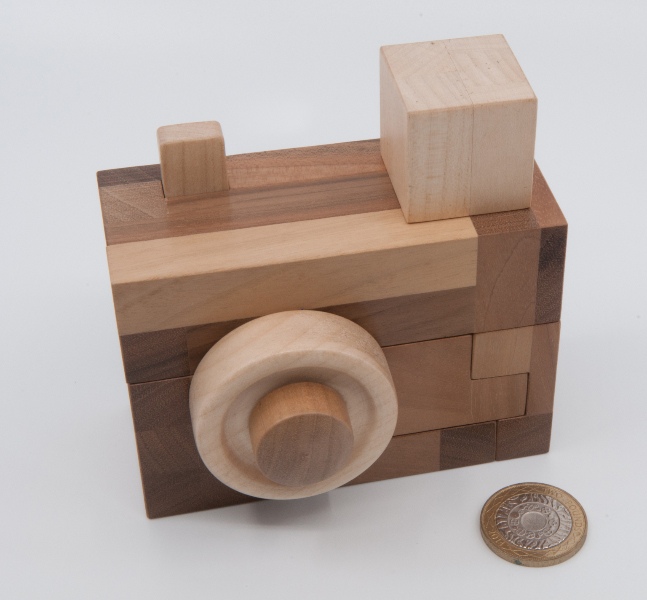
Ages ago I spotted a picture of a Kumiki-style camera on Bernhard Schweitzer’s site which I subsequently discovered had been designed by William Waite and made by Pelikan. The Camera Conundrum had received an Honourable Mention in the IPP23 Puzzle Design Competition – so I set about trying to find one…

Recently the good folks at the New Pelikan Workshop recreated this old classic and it was briefly available for sale once more – sadly I missed that opportunity and my search continued. But my dogged determination recently paid off when I found a copy of the original Camera Conundrum available for sale… I did not miss out this time! 

Resembling an old instamatic camera with a magicube flash on it [remember those?!] it’s a handsome little puzzle whose aim is disassembly and reassembly, finding a hidden compartment along the way… the coolest thing though is how various actions that you’d associate with those old cameras have been incorporated into the solution. 


At some point during the solution you’ll press the shutter release, manipulate the flash, focus the camera and wind on the film [actual film, remember that?!]. 


Somewhere along the way you’ll discover a drawer with a secret little hidey hole – plenty big enough for a standard ball bearing noise-maker, it turns out. 


Even with a pile of pieces, it’s not horribly complicated to work out where things need to go, and there’s a reasonably logical progression to building up your little camera… you have to love the way William’s made so many of the moves resemble things you’d actually do with these cameras.

The second camera comes from Hideaki Kawashima – one of the indecently talented gentlemen of the Karakuri Group. Back in 2014 he produced a fiendishly difficult Twin Lens Reflex Camera whose second compartment had me baffled, and he’s done it again with his Spring Camera. 


This one resembles an old vintage Voigtlander from around the 1930’s. Once again the detailing on the camera is stunning – you get the impression that lots of the detailing is there purely to make it look the part, but you won’t shake the feeling that some of those little thingies are going to be helpful in opening up this box…


…and so it is – find the right things to do and the front panel opens and the lens unit pops out – all very theatrical… you’ll find yourself closing it up and popping it open over and over again – it’s quite addictive. 


Get that far and you have a wonderfully functional little object… but still no idea of how to open the box… that takes a few more moves and some imagination… applied liberally and you’ll find you way into the little treasure compartment.


An absolutely stunning piece from a young man who is clearly passionate about his photography as well as his woodwork – the photos he puts up on his Instagram feed are fantastic – occasionally there’s even a puzzle pic or two on there…


Here’s hoping there’ll be even more little wooden cameras in future…