Showing posts with label Lee Krasnow. Show all posts

Saturday, 10 August 2024

Get into the Spirit

I’m sure the other exchangers in this year’s Edward Hordern Puzzle Exchange won’t be too offended if I describe this as the stand-out exchange puzzle this year… an absolute thing of beauty inspired by the man behind Boxes and Booze and superbly crafted by that bloke at Pacific Puzzles - Steve Canfield and Lee Krasnow set the bar(!) incredibly high on this one…

Inside the green velvet pouch nestles a shiny aluminium cocktail shaker - the only potential giveaway that this might not be just an actual cocktail shaker is the wooden trim around the waist- that and the lack of a cap on the top… this one absolutely looks the part!

Your goal is to free the commemorative coin that you can catch a glimpse of fairly early on in the solve - however it remains annoyingly out of reach until the very end!

The first move is probably best described as a bit of a “gimme!” - you’re going to find it and then you’re going to have a bit of an intake of breath when you start seeing some of the bits lying in wait for you… it looks impressive!

I spent quite a while getting nowhere at this point. I’d fiddle with this and with that, and not find anything useful… but the whole time I found myself absolutely enchanted by this object’s gorgeousness, so spending time in one spot isn’t really much of a chore!

It took me quite a while to find the next step, and of course immediately realised I was overcomplicating things as usual… it’s an elegantly simple mechanism…

Right about now things began to get really interesting, and while progress started to come thick and fast, some pretty weird stuff was happening… at one point I didn’t think things through and ended up cursing that man Canfield… and I’m sure I wasn’t the first, and won’t be the last! (Feel free to have a laugh at my expense, mate - well-played!!)
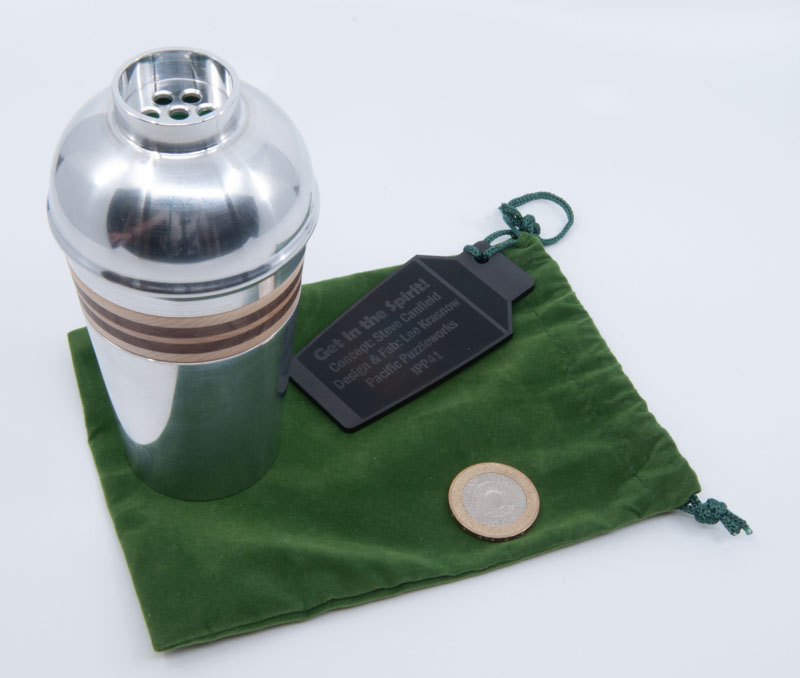
Freeing the coin provides a nice reward and a little hit of dopamine…I spent a while enjoying that hit (they don’t come that frequently, so I need to make the most of them!) and then duly found myself getting tripped up all over the show when I set about resetting the puzzle - it probably took me three or four goes to get everything back in the right place - and each time I cursed that man Canfield… if you know, you know… :-)

This is an awesome puzzle - plenty of discovering is required and a good deal of Think-(c)-ing needed too… this is going to be the Big Ben of 2024. Chapeau gentlemen!

Tuesday, 19 February 2019

Barcode Burr Master Set (collector's edition)


Lee Krasnow has been known as a creator of some very ingenious and indecently finely-toleranced puzzles for many years. Cheap or plentiful, they were not. Amazingly well-crafted they certainly were. It goes without saying that they were massively sought-after by puzzle collectors around the world… IMHO his Barcode Burr was his most special creation.
Recently, Lee began experimenting with a 3D printer, and found that the outputs were pretty good, so he got a few more and began selling various 3D printed puzzles on his etsy shop – while making the STL files available for free for anyone who wanted to print their own at home…lord knows how many printers he currently has rattling away in his shed (they’d have to be, wouldn’t they?!) but he is producing a prodigious number of puzzles for what must be barely more than it’s costing him to produce them.
By the time I got around to ordering a Barcode Burr (let’s call it a BCB from now on and save me lots of keystrokes!), Lee was offering a set that came with a standard BCB, and a set of replacements arms and mazes that would transform it into a number of variants – based on some work that he and Derek Bosch had done… many puzzles is always better so I ordered the set.
The standard 3D printed BCB has one very important thing going for it which almost makes it better than the original: it’s AVAILABLE! Don’t get me wrong, I love my wooden copy and you’d need to pry it from my dying claws… but you can’t get them for love nor money! The 3D printed versions are getting churned out by the dozen… and they work beautifully – seriously, Lee has done an excellent job of engineering them to go together perfectly, and then play rather nicely.
I can vouch for that because the standard copy got played with before I set about assembling the first of the alternate versions – assembling the six main parts form the base pieces, maze plates and arms was a piece of cake with everything going exactly where it needed to and things lining up perfectly. Assembling the six bits in the cube confirmed that everything interacts perfectly.
Having assembled the first alternate version, I struck a bit of a problem: if I wanted to assemble the next one, I’d need to sacrifice one of the BCBs already assembled to get the base pieces I needed… hmm.
I ruminated for a while and then dropped Lee a note asking him if he’d mind selling me some extra base pieces so that I could have them all assembled at the same time… his response suggested that I hadn’t been the only one asking that question and shortly there were some options up on the etsy shop to allow any combination of pieces to be collected…. And I now have a complete set of the variants sitting on my shelf – pieces assembled and duly put together by my fair hands, albeit referring to Lee’s solution card for some of them – the n-ary versions are simple enough to work out yourself, but some of the complex variants are aptly named  [ExtremeTortureCode Burr, I'm looking at you!] and I feel no shame at having followed the assembly sequence slavishly.
If you like n-ary puzzles, you’ll get a kick out of this set – and by all means, if you’re proficient 3D-print-meister, have a go yourself… but I suspect you’ll struggle to produce them as nicely as Lee does and they’re a steal at his prices anyway.
Yes I’m a fan… and yes, I’m eyeing up the set of co-ordinate motion BCBs that have recently appeared in the etsy shop… it’s probably just a matter of time!

Saturday, 27 January 2018

More diagonal silliness…


Once or twice in the past I’ve mentioned that I like finding puzzles that look ostensibly alike, but are really totally different puzzles… in fact I’ve even written about a pair of puzzles that look identical from Lee Krasnow over here – so imagine my delight when I stumble across a few more variants to add to the Krasnow bit of the collection. 

First up is the plainest looking of the trio – it is the standard Coffin Star design (SC-04), aka the diagonal burr. The fit on this little sucker is just so darn good that the usual trick of tugging on adjacent pieces does absolutely nothing… spinning it – likewise… until you pay this innocuous looking beastie due respect and adopt the correct grip and pull it apart on the correct axis, it will simply stand there and mock you. 

Those pieces continue to grip together like there’s no tomorrow until they physically pass beyond just the tips holding things together… I’ve never seen a diagonal burr that hold on quite like that one…

Next up looks ostensibly the same again, except it’s made in far prettier woods this time… and unusually for Lee’s work, the pieces feel a bit loose when you pick it up… and that gives you a bit of a clue to what’s happening inside – take this one apart and you find it has a cubic cavity in the centre – this is Coffin’s Star variant 4B(?). Having had that central little bit of the puzzle removed means there’s a lot less wood to grip between the pieces when it’s assembled, giving it the slightly loose feel, but when it comes to reassembling this guy you really miss those central pieces! 

If you’re anything like me you assemble the two halves in a three-fingered grip and then slide the halves together… which is usually pretty simple – but this variant’s missing bits mean that you can’t just squeeze the three pieces together in each hand, you have to hold each of the three pieces in the right place relative to the others, without the bit in the middle that you’d normally be pushing against… which makes this fella pretty fiddly to reassemble – not horrible, just tricky!

The final new addition to the canon is the Sneaky Star… looks just like a Coffin Star (give or take the fancy spalted wood) but it open in a rather different manner… and like 4B it has a cubic cavity in the centre – except this one comes with a pretty little cubic box in the centre – a puzzle box that is one inch cubed – and it’s called Inchricate. It is a fine puzzle on its own… 

I’ve given it to a few puzzlers over the last month or so and virtually all of them have wondered out loud if I was having them on, sought encouragement and even advice. 

It’s an excellent little box that uses most of what you “know” about puzzle boxes against you… so some of the moves are unconventional to say the least, so of the usual “rules” about “once this face moves, that must be the next face to move” are deliberately flouted, resulting in a wonderful little puzzle box challenge that literally fits into a 1 cubic inch cavity inside the Sneaky Star. 

It’s sneaky and brilliant!

Monday, 22 August 2016

Diagonal burrs


A few months ago I treated myself to a pair of puzzles from Lee Krasnow: a matching set of a Diagonal Burr and Coffin’s Pseudo-Notched Sticks… I’d loved the idea of getting a pair of these to have lying around to demonstrate to non-puzzlers that what-you-see isn’t necessarily what-you-get with puzzles – in fact sometimes those darn puzzle designers try and use that against you.
(Shock! Horror! No, we’ve never been caught out like that, have we?!)

The standard diagonal burr is made up of six identically notched sticks that slot together in a standard six-piece burr shape except that the sticks are all on the diagonal instead of being flat against one another… pulling any set of adjacent pieces apart will almost instantly reduce the assembled puzzle back to the pile of pieces it started out as – and assembly is only slightly tricky as it needs to be built in two sub-assemblies that are offered up at the end.

Pseudo-Notched Sticks is another animal altogether – designed to look exactly like its simpler brother (aka ole Notched Sticks) when it’s assembled, there is no hint of familial resemblance when looking at the unassembled pieces… and indeed the standard approach of gripping adjacent pieces and pulling them apart sideways won’t help you disassembling this guy at all, in fact you’ll be pulling against yourself all the way!

Lee’s set comes beautifully presented in his customised boxes, with woods neatly matched between the two puzzles so that they actually look pretty darn similar when they’re assembled next to each other. As you might expect with Lee, though, the matching goes a lot deeper than just choosing bits of similar wood… while the standard diagonal burr is normally made of single sticks with notches cut in them (can you tell where the name comes from yet?!) Lee’s copies have the sticks made up of three separate pieces, so that when you examine the two puzzles next to each other there’s no visual clue as to which of the sets is Pseudo and which isn’t… a thoroughly bonkers attention to detail that deserves calling out!

One of the little delights of having a perfectly made set of matching pieces is the ability to put together some Franken-puzzles combining bits of both sets – and still producing a set of matching puzzles… neat, eh?


Variations on a theme

Having just written about the standard Diagonal Burr, I should mention a couple of variations on the theme from Mr Puzzle that turn the simple puzzle into a somewhat less simple one…

 
First up is a Stuart Gee design called Diagonal Twins that mates a pair of Diagonal Burrs along a shared axis – although you’ll need to think about the axis a little… a few of the pieces are a little unusual but most of them are your standard common-or-garden notched sticks… the number of non-standard sticks gives a pretty good clue to how they’re going to be used, but I still found I needed to think things through to find the appropriate assembly.


Brian Young’s Insoma Burr takes things to an all new level of complexity, however. On the outside it might look a bit like a stylised diagonal burr, and it certainly comes apart like a diagonal burr, the insides are nothing like a standard diagonal burr… each of the main pieces has a piece of a Soma Cube attached to its centre, with the final piece (because a Soma cube has seven pieces) free to be placed in an appropriate place. 
 
Now if you know your Soma cubes well you’ll know that there are 240 possible cube assemblies – however you’ll find that attaching them to the insides of a diagonal burr will restrict the number of achievable assemblies quite a lot – in fact it restricts them to a single solution… making this a very challenging somewhat distant relative of the standard Diagonal Burr… 
Not to be taken lightly!