Thursday, 23 August 2012

IPP Thursday afternoon


Gill and I spent the morning wandering around some of the monuments in DC on our own, having navigated the Metro into the centre of town (not an especially tough puzzle, to be fair) – we watched aircraft wheeling into Reagan and banking across the Jefferson Memorial while tourists pedalled boats on the river. Weaved our way between sprinklers dodging the spray through the parking lot, thinking more than once that it might be rather pleasant to wander into the spray for just a bit, then noticed a young girl doing exactly that. A few minutes later a large white van drove past us and stopped at the corner for two huge guys to get out and go and stand in the middle of the spray, arms outstretched cooling down – perhaps it wasn’t just us tourists from England who were feeling the heat that morning.

We sat on the lawn at the Washington memorial (in the shade!) and took some pics before heading up toward the White House for yet more touristy pics. From there we wandered across to a cafe for an iced coffee and some a/c – not sure which one went down better! After a short wander through the shops, we took the Metro back to Pentagon City where we found a Johnny Rockets (long story, but we like the milkshakes and burgers) so decided we’d have to come back there again...

Back at the hotel I got distracted by Pavel Curtis introducing some of his word games to Bram Cohen and a small group of puzzlers so I stopped and joined the puzzling – really enjoyed the multi-layer combination of a physical puzzle and several layers of word-puzzles and some serious lateral thinking – all of them gave some really good A-HA moments a few times through the solution process.  Not sure how far we’d have got without Pavel’s expert gentle guidance from the sidelines when we got stuck though.

During the afternoon I met the amazing force of nature called Stephen Chin (or more commonly Chinny or Chinnomoto) and Matt Dawson who gave me a lovely box of chocolates (the state’s finest!) as a thank you for connecting him to some folks back in the UK who were interested in getting hold of a copy of his exchange puzzle – heck that was easy – and I got a box of chocolates for my “trouble”.  I met Derek and Michelle Bosch and got introduced to little Ann who was doing her impression of the best behaved toddler in the world at the time! I congratulated Derek on opening his Revomaze Gold during the past week and we chatted a bit about it as a puzzle, or not... and "recent developments".

I met Ken Irvine, another first-time IPP-er who was generally around with his rucksack full of new designs – always happy to take them out for folks to play with. They turned out to be a huge hit and I’m sure that Ken got sick and tired of telling folks that he didn’t have any for sale, he’d just brought one of each of his designs for folks to play with ... although as I write this, Tom Lensch and Eric Fuller have already committed to producing some of Ken’s designs and Bernhard Schweitzer has also been making promising noises along the same lines, so hopefully they’ll be available in due course – the designs I had a crack at were all excellent ... one of them has all the feel and play of one of Mine’s cubes, except it doesn’t have the little tricky bit to it ... making it more of an honest puzzle, but just as much fun to play with!

The puzzle design room sucked me back in again and I had a wonderful time playing with some of the designs, again. This time with a little more success!
Peter Wiltshire’s Ferris’ Box is a truly excellent puzzle box – it looks like a 3*3*3 cube inside a maple frame and none of the usual tricks seems to do anything, but when things do start to move, boy are they interesting! It was a really fun box to solve and a real treat to play with – Peter’s crafting skills are superb and it’s not hard to see why it won the Jury First Prize ... Peter made a limited number of them and most of them will be in the Apothecary Chest project ... a few of which might be sold off once the project is complete. I suspect he must have gotten sick and tired of the repeated requests for one of his boxes because he’s subsequently decided to make a further four copies, in different woods to set them apart from the first limited edition run and sell them via one of the puzzle auctions ... keep an eye out for that one, it’s a cracker!

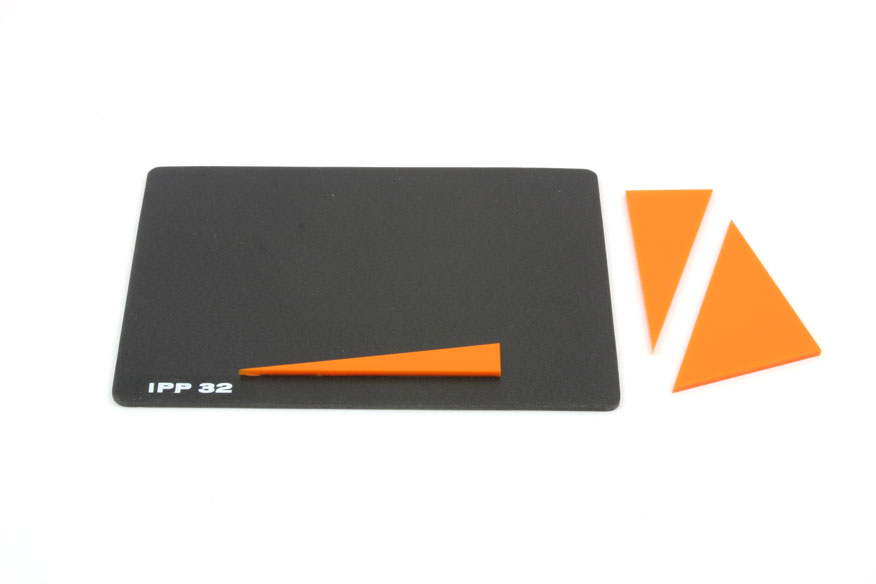
I made absolutely no progress on the Packman puzzle (again!) but did manage to solve Double Symmetry (the three orange triangle puzzle) which sort of surprised me as I am usually rubbish at that sort of puzzle (making symmetrical shapes from weird pieces). This puzzle gives you three odd triangles and asks you to make a pair of symmetrical shapes...

At one point I found myself puzzling next to Brian Young so introduced myself and we ended up chatting about life, the universe and puzzle blogs. 

Neither of us was convinced that his linking to my blog posts had actually done much for his sales, but at least I was able to name a couple of folks who’d bought an Opening Bat after seeing mine and hearing about it. While we were talking about his Opening Bat he told me about one of his serious collectors who’d sent him an email just after he’d received his copy saying “Is that it?”. Brian suggested he reserve judgement until he’d at least tried playing with it first, and several days later there was another email along saying “Ah, now I understand...” – Brian wouldn’t say how long it subsequently took him to get through all three locks properly.  It was great chatting to Brian and really felt that we came at life from a similar perspective – perhaps it’s a Southern-Hemisphere-approach-to-life-thing?

Eric Fuller and Robert Yarger whirled through the design room and the registration desk in a bit of a flurry – one had mailed his gear for the evening do along with his puzzles and the other had been delayed, and they were sharing a room ... all ended well, with the two of them making the do in the evening with plenty of time to spare ...more on which in the next post ...

Sunday, 19 August 2012

IPP 32 – the beginning


OK – it might be a bit after the fact (Gill and I spent a week in NYC after IPP, hence the dearth of blog posts over the past few weeks, except for the ones I teed up before I left) , but here we go – the newbie’s take on IPP32:

WOW!

That is all.

Anything else that I say about it now is not going to do it justice. Trust me.
In fact that was one of the conversations that Neil and I had toward the end of IPP: How the heck do we write about this and convey the shear awesomeness of it all? And we both concluded that you couldn’t, so best not to try...

So what you are going to get from me are some stories and descriptions of some of the events from my point of view ... as usual they’re going to be personal stories and they’ll give you a flavour of what IPP32 was like, but if you’re looking for the blow-by-blow description, sorry, I have a day-job (and a wife and two dogs who haven’t seen me for a while!).

...OK so let’s start at the top – Gill and I took a flight out of Heathrow into Dulles and it was pretty uneventful – uneventful flights are good flights! Walked off the plane into a wall of heat and humidity – realised how much we’d missed the simple things in life... sunshine!

Cab to the hotel was deliciously cool and after checking in and recognising a couple of name tags on the way up to the room to unpack, we wandered down to the IPP registration desk. I walked up to the desk and said “Hi I’m Allard Walker” and I was met with a wall of smiles, introductions and hands to shake – Brett Kuehner made it his job to introduce me to everyone around at the time (most of whom seemed to be related to him – turns out he’d roped pretty much his whole family in to help out!) and sort me out with the registration pack, name tags for Gill and I, we had our photos taken, collected the IPP t-shirts I’d ordered and had a quick lesson in the badge puzzle (more later, promise!) before we wandered back up to the room to dump the shirts and the welcome pack and headed back down to the bar area (for some reason the bar / lobby always seems to be the hub at these events!).  Our badges had a green background for our delegate numbers which marked us out as first timers and that little detail proved to be a great conversation starter over the next few days...

Down at the bar I recognised a face from one of our MPP meetings (Richard Gain) and recognised a voice from a set of video reviews – caught his eye and introduced myself to Neil Hutchison – The Juggler.  Wil joined us a while later and started telling us a sob-story about being stopped by German customs who then took his Peppermint Stick puzzle apart so he asked me if I’d mind reassembling it for him – it would probably be rude to refuse, so I sat down and tried, only it wouldn’t quite go together properly, until eventually I looked up and asked Wil if this was actually a Peppermint Twist or just a matched pair of twisted wires – they didn’t seem to want to bite together ... and about the same time I noticed Wil being even more conspiratorial than usual and smelled a rat ... at which point he gave me the fifth piece of what I’d assumed was a four piece puzzle – after all my copy is! It went together pretty sweetly after that, much to everyone’s amusement!

We chatted for a while and then, having established that most folks had already had dinner, we took up residence in the bar proper with a couple of puzzlers off the Renegades forum and I took out a couple of puzzles for folks to play with.

While the blokes began talking and playing with puzzles, the girls struck up a conversation and before long Jen (Neil’s partner), Lesley (Peter Wiltshire’s wife) and Gill (my far better half) had realised that they had lots more in common than being puzzle-widows – they shared a bunch of hobbies and interests (it seems that puzzlers’ wives are a pretty crafty bunch!) and a serious passion for shopping!

I’d taken my copy of Louis’ A-Maze-Ing box along for the ride, pretty sure that not many people had seen one (!) – before long Peter Wiltshire had passed the box onto Jim Strayer who proceeded to open it ... 
Peter rather kindly gave me a great little cube that he'd made and it kept me occupied for quite a while, with Neil peering over my shoulder and saying not-very-helpful things - all puzzlers are alike it seems! 

Peter had worked his way through my copy of Wil’s Washer Cylinder with a little bit of encouragement from Neil and I in between a bunch of friendly puzzle-banter ... hard to believe I’d only just met these guys.  

Mine’s Little Twister had come along as well, and although it didn’t come out quite as often as the A-Maze-Ing box, it remained undefeated during the entire IPP.

Neil had brought along a few copies of Derek Bosch’s Hex Stairs puzzle that he’d made for the puzzle party and had brought a couple down for me to choose one from the different woods he’d made them in, along with a tiny copy he’d been experimenting with. I began fiddling with the tiny one after a little encouragement from Neil, only to find that I couldn’t get it back together again – the tolerances are so fine that unless you had everything perfectly aligned, it will not go back together again – so Neil helped me out with that one. Having chosen one of the larger ones to buy, we played with that, with Jim Strayer giving us all a good laugh a few minutes later with his “Gosh, that sucker’ll come right apart on you!” while he was fiddling with a copy.

While we were sitting chatting, I recognised Rox from the photos on her blog as she wandered over to say hello, to me ... and then she spotted a pile of twisty puzzles and she was off again.

A couple of times over the course of the IPP I found myself using the same description, I felt like I’d found my tribe, my clan – they were just like me, shared my interests and didn’t think it was weird to enjoy being puzzled and collecting puzzling things.

A bit later most of the girls had wandered back up to their rooms and one of the committee came over and announced that the design competition room was opened – clearing the room of pretty much all of the puzzlers instantaneously ... except for me – I’m a bit slow ... I eventually caught up with the rest of them in a room full of new puzzles waiting to be explored ... this really is like being in puzzle heaven – the very best  new puzzles crafted by the best craftsmen out there, all neatly laid out for anyone to have a go at.

A bunch of us were spread out around the room puzzling, mostly in silence, but every now and then there would be a salvo of banter at someone’s expense and a round of laughter before the puzzling continued. I’d come across Simon Nightingale in the puzzle room and said hello and settled down to a cute little bowler hat assembly puzzle that I later discovered was from Kohfuh – and I was quite chuffed that I’d managed to solve it reasonably quickly, especially after Simon’s warnings on how hard it was likely to be – I must have got a little lucky as there was a neat little bit of misdirection in the shape of the pieces...

I also had a go at Jane Kostick’s  Chamfered cube – and managed to get the assembly together fairly neatly – I really enjoy playing with her puzzles, they have a nice satisfying feel when the magnets grab and they slot together neatly. She’d entered a few separate puzzles in this year’s competition and they were definitely more puzzle-y than her entry from last year.

Being a bit of a puzzle box junkie I had a brief bash at The Vault, realised that the tool was a flash-light (Hey, it was more than some folks managed – several of whom were spinning it and whacking it on the table, although nobody blew on it while I was around) but didn’t really get much further than that.

I crashed at about midnight, which given I was still on UK-time made it about 6am already ... and slept like a log until 3am...

...and that was my first day at IPP – not bad given that we only got into DC after 7pm...

IPP 32

...just got home after IPP32 and a few days in NYC - still need to unpack properly - blog posts will follow, promise!

The aftermath:


Wednesday, 15 August 2012

A toast to Akio Kamei

Kamei has been producing great puzzles and inspiring a new generation of puzzle craftsmen for some time now. 

His latest version of the Whiskey Bottle puzzle box was created in 2008 in walnut. The earlier version from 1983 had been crafted in a much lighter wood and the new version is described as being essentially the same as the earlier version except that the mechanism has been improved and should be more robust … so now you know!

I’ve always thought of this as one of the classic Kamei designs, so when I saw a copy come up for sale, I dived in and a short while later the bottle had travelled from Brussels to Barnt Green and I was happily puzzling.
This puzzle shares a common theme with a couple of other designs where there’s a pretty obvious “secret” compartment that you’ll be forced to find rather quickly – in this case the mere act of picking the bottle up (in a certain way, admittedly!) gives you access to the first compartment – a little drawer inside the top part of the bottle… 

What’s not so obvious is the presence of a second (really!) secret compartment and that’s the real puzzle. That compartment is rather neatly hidden and requires a few moves in order to open it up properly – one or two of them are a little unusual – they won’t slow down an avid puzzler, but they will certainly mislead the casual metagrobologist into thinking they’d completed the task and totally miss out on the real puzzle.

I think this one’s a classic – it looks great among the other puzzles and it stands out rather nicely due to it’s size. It certainly looks the part and it’s good to have one in the hoard!

Saturday, 11 August 2012

…more Coolen Creations

1st prototypes
With any luck, when this post is published, I’ll be enjoying the delights of the 32nd International Puzzle Party. Somehow I managed to blag myself an invite in spite of a pathetically small hoard of puzzles and only really having been a slightly serious hoarder for the past three years or so. (Yip, I still can’t bring myself to refer to what I do as collecting or to myself as a collector.)
The IPP is an amazing opportunity to meet puzzlers from around the world, chat to world-renowned collectors, designers and craftsmen about the things they love and share stories about puzzles and puzzling … and I’m sure I’ll be boring you senseless with stories from IPP for a while to come, but in the mean time, here’s the story behind my IPP gift…
...all the prototypes
As a newbie at IPP I thought that it might improve my chances of being liked and accepted (and more importantly, being invited back!) if I took along some little puzzling gift-type-things – you know, bribes! However, as I’m not a designer or a craftsman of any note (any note!), I  was always going to rely on getting something made by someone with far more talent than I have. And given that the target audience here are the world’s greatest collectors, designers and crafters of puzzles, you can’t exactly pick something up off the shelf and make a good impression – so I set about trying to come up with something unusual. 
Final candidates
My first attempt was getting some jigsaw coins cut with some suitable letters cut out of them (IPP 32) – but unfortunately my emails went unanswered so that one didn’t progress any further than an initial enquiry.
My next attempt was foiled when the gent I was hoping could produce something unique for me ended up getting horribly over-stretched at work and totally unable to take on anything extra.
With a couple of weeks to go before IPP, my puzzling mate Louis goes off on holiday with his family and a couple of decks of cards, as you do. Louis had read my blog post on impossible card-folding and decided to have a bit of a bash himself while he was on holiday. Before long he was sending pictures of his work to a couple of us in emails and he’d produced some pretty impressive stuff, so I asked him if he might be interested in producing something for me to dish out at IPP.
He dived in enthusiastically and over the course of the next few evenings produced a couple of alternative designs that he’d email over and we’d discuss, and then a day or two later, some improved designs would arrive until about a week later – and having destroyed at least an entire suit, we’d more or less decided on the features to include and Louis went into fine-tuning mode.
He went out and bought a bunch of different types of playing cards so that he could experiment with designs on the different types of cards and it soon became apparent that not all decks of cards are created equal – and the one I’d thought most suitable turned out to be an absolute pig to work with, so it was dispatched to the junk pile.
We eventually settled on a standard blue-backed Bicycle poker deck and Louis sprang into action setting up a manufacturing process that roped in Mieke with Laura keen to help out as well …
In an attempt to work out how long the postage from Eindhoven to Barnt Green would take, Louis sent over a test package of the design candidates and there was a little bit of nervousness while we waited for the envelope to wander across the channel – and I have to admit that from time to time I had visions of them not getting here in time for me to take them along… but in the end, they got here in just less than a week, which meant that the real ones should all get here in time … even still, we split them into three separate shipments to reduce the risk of them all not making it.
...in case you were wondering...
I did the easy bit once Louis (and Mieke!) had produced all the cards, and printed little frames to mount them on and bagged them all up ready to take along to IPP… cunningly adding a QR code inside the frame that points at this blog post – just in case anyone hasn’t read my blog yet!
I think that Louis has done a pretty awesome job on these – I think the design is clever and really shows off a couple of interesting little “features” to get the brain working a little – it’s one of those things you can glance at and totally miss some of the subtleties- so I’ve tried to highlight a couple of them in the close-up pics …
I reckon they are going to go down rather well at IPP …Thanks Louis! Awesome job, mate!
The business end.


Tuesday, 7 August 2012

Thoughts before IPP


It feels like ages ago that I first read about these mythical gatherings of the-great-and-the-good in puzzledom. Gatherings where the great puzzle designers and collectors got to chat about life, the universe and why puzzling makes both of them better. Fantastic design competitions only open to new puzzles where the best puzzle craftsmen would show off their skills in an attempt to bamboozle all comers. Talks by people whose names are instantly recognised by anyone who’s vaguely interested in puzzles … gala dinners, tours and entertainment and puzzle-trading and selling, the likes of which you have never experienced before - all of this in interesting cities all around the world – sounds dreadful, doesn’t it!
When a few of us realised on one of the puzzle forums that we lived reasonably close to one another, we started getting together every now and then to chat about puzzles and share new acquisitions. The topic of IPP invariably came up and they sounded pretty special – thinking that they were all well beyond anything that we might aspire to, we decided to do the next best thing and hold a mini puzzle party of your own in the Midlands – and the MPP was born.

Ten or fifteen of us got together every few months to show the others what we’d managed to find in the interim and have a bash at everyone else’s puzzles. There would be chat about the latest finds on the inter-web and every now and then folks would ask about the IPP – and usually the closest we’d come to it was someone had met someone (probably at one of the Camden do’s!) who’d been to IPP … and then toward the end of last year, something strange started happening – a couple of our merry mob went along to the Dutch Cube Day and met some of the leading lights in puzzledom – and they were just like us – they also wanted to chat about puzzles and enjoyed fiddling with others’ designs and talking about what made a good puzzle.
Some of our number began going along to the monthly puzzle do’s at Camden Lock and started broadening their circle of puzzle mates – and that bunch included heaps of IPP-regulars. And then James Dalgety invited the bunch of us down to Devon for a day’s puzzling and we got to meet a bunch of new puzzlers (several of whom live reasonably close to us in the Midlands), several of whose names we recognised from that puzzle design competition and from reading about the IPP. I went along to Peter Hajek’s EPP and met another bunch of reasonably local puzzlers who’d been designing puzzles for ages … so we did the obvious thing, and invited them along to our next MPP, and they came along and even seemed to enjoy themselves.
What was weird, was noticing that over the course of the year, our ring of puzzle pals seemed to expand exponentially to include a whole whack of IPP-regulars – and we went from just reading about IPP to knowing folks who’d actually been involved for years and years.


Somewhere during all of that, I’d started talking about IPP to a couple of folks and got a steer on how to express an interest in the right direction, and then with a bit of help from some of those puzzle friends, managed to get invited to the next IPP later this year.
So here I am – having looked up at the IPP as the annual puzzling pinnacle, knowing that I’ve been invited along to the next one, and feeling more than a little daunted at the prospect!
Oddly, it seems I’m not alone … and in fact it also seems that the organisers understand that and try and make newbies like me feel welcome! When I’d hinted to James Dalgety that I might be a bit nervous of what might happen, he did the kindly-uncle-thing and told me not to worry, all first-timers get a special indicator on their name tags (everyone wears name tags all the time!) and everyone else is instructed (his words! :-)) to be nice to the new folks.


Wherever I saw anyone else expressing a bit of trepidation about their first IPP on a puzzle forum, invariably they’d be swamped with reassuring messages from the old hands.
In the past I’ve commented on the fact that I’ve never come across a real puzzler who wasn’t a really nice person – be that at our own little puzzle parties, on puzzle forums on the inter-web, anywhere in fact. I suspect that my theory isn’t going to be called into doubt this time around either.

Sunday, 5 August 2012

More Strijbos Dovetails!


If I didn’t know better, I’d think that Wil Strijbos had a thing for dovetail joints – not content with bringing the puzzling community a pair of concave and convex impossible dovetails, Wil recently added not only a third one to that set, but also an entire new set of Impossible Dovetail Cubes in some really funky colours.
Dovetail the third, adds a new twist to the Convex / Concave Dovetail set, although the family resemblance is still clear through the common colouring of a green piece and an uncoloured aluminium piece. From some elevations this dovetail looks quite pedestrian, however when viewed from the top, the brain gets a little frazzled. More so if you happen to see the edges and the top together. 

As usual there’s a locking-mechanism in there to be defeated before the two pieces can be parted – and in case you’re wondering, yes, each piece is a single colour!

Wil’s standard challenge with his dovetails is for the puzzler to work out from an inspection of the outside, what the shapes of the pieces must be in order for this to work – and this one presents a rather neat little mental challenge … in fact if I hadn’t seen one made in wood a little while ago and seen some notes on making them in E.M. Wyatt’s classic book on crafting wooden puzzles, I’d have been scratching my head for quite a while longer!
The Dovetail Cubes are a reasonably recent addition to the family and come in rather colourful varieties. Externally, the cubes all look mechanically the same – all impossible, but all the same. They each appear to have a set of crossed dovetails with a dovetail joint between the top and bottom halves on each face. Wil’s challenge to puzzlers is to work out how they might work mechanically, while telling you that all three are quite different.
The cubes employ a locking mechanism as usual and each have their own little surprise when you open them up … they are all totally different and if you haven’t already played with this sort of puzzle before, you’ll probably find at least two of them are a little unexpected. Once you see the mechanism, they make total sense and it’s hard to get them out of your mind (a bit like learning the secret behind a magic trick – the trick and the accompanying wonder are banished forever) – but what lasts for ages is the quality of the machining and the fit between the pieces – the tolerances are really exceptionally tight leaving no slop in the fit at all.
When Wil was visiting a short while back, he had a couple of prototypes for us to fiddle around with and he was explaining that one of them required some custom-made tooling to machine – and you can see why – but the results are terrific.
One little finer point I really liked was the attention to detail on the locking mechanism, where an extra piece or two has been added to trap the mechanism and prevent it from falling out when the pieces are separated … nice!
If you like Wil’s (not-so-)heavy metals, then you really ought to add a set of these to your collection – fun to fiddle with and a nice little challenge for non-puzzlers to think about.

Thursday, 2 August 2012

A bit of Karakuri fun


I recently managed to come across a couple of rather fun Karakuri puzzles that I hadn’t been able to get my paws on yet. 

Bento Box is probably the simplest of the three Karakuri boxes in this post. Crafted by Hiroyuki Oka since 2007 and made to look exactly like a Japanese packed lunch, this box comes with a napkin and a set of chopsticks – see, I told you it looked just like a Japanese packed lunch! 

The lid lifts off the box to reveal the wooden meal inside – and it’s a rather neatly laid out traditional meal. A couple of little delicacies and a decent sized, if slightly hollow, portion of rice. 

Experimenting a little will lead you to notice that the most likely secret-compartment-hiding-place is in the boiled rice space, and a little bit more fiddling around will identify the one or two moves needed to access it ... not especially challenging, but a very unusual-looking puzzle box – and I like the way that the various elements of the meal need to be used in order to open the box. 

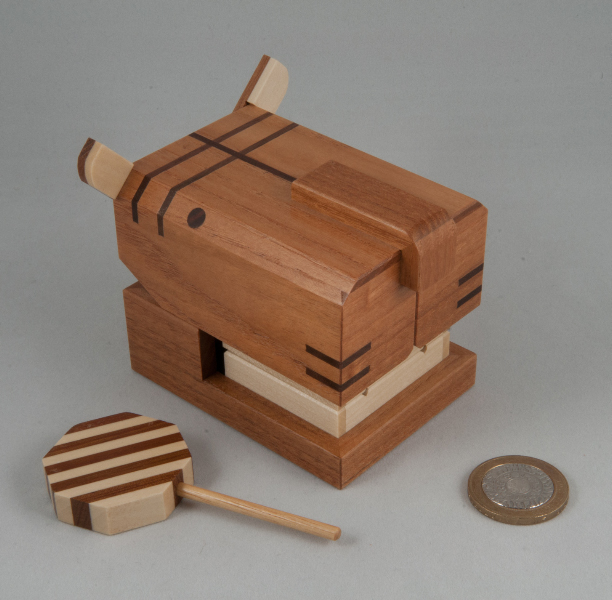
The next two little boxes are both products of the incredibly creative Shiro Tajima. Tiger of Carboholic was his 2009 Karakuri Christmas present and I’ve had a bit of a soft spot for it for quite a while. The toothy grin on the tiger, coupled with the slightly incongruous accompanying lollipop made it look rather intriguing. 

The tiger will open his mouth and yawn, and merrily chomp on the lollipop – and you can probably work out where the secret compartment needs to be, but there are a good few little red herrings to take you off track and keep you playing with this cute little puzzle. 

The solution yields to a bit of Think(c)-ing and considering what you can and can’t do – although it sometimes needs a little bit of “encouragement”. Definitely one of the cutest little Karakuri boxes out there. 

The last puzzle in this post is Dragon Wing. I remember there being quite a bit of speculation on one of the puzzle forums when folks realised that Shiro Tajima was producing puzzle boxes based on the Chinese Horoscope, and that 2011 was the year of the dragon ... the year before he’d produced a rabbit popping out of a top hat for the year of the rabbit – so what would he come up with for the year of the dragon?

I’d been hoping to get a copy of that as a Christmas present but lost out on the ballot as it was oversubscribed, so I was delighted when I managed to snag a copy recently. 

At the start of the puzzle, the dragon’s wings are securely locked down, so the first order of business is to release the poor beast’s wings so that he can fly ... and having done that, it’s pretty clear that there’s a compartment to be opened in his tummy – I say pretty obvious because it sort-of wiggles around quite a bit while you’re experimenting, but in spite of its wiggly-ness, it remains firmly attached.
 
You’ll need to spot a couple of other little things that might be useful, and then work out how to string them together before you will manage to release the cute little beastie’s tummy. 

Cute little beggar ... anyone for a snake next year?

Sunday, 29 July 2012

James Dalgety’s Pythagorean Puzzle


I know – you really don’t deserve this... but I remember a shaggy dog story from my school days that went something along these lines: 

There were three Indian squaws. One slept on a deer skin, one slept on an elk skin, and the third slept on a hippopotamus skin. All three became pregnant. The first two each had a baby boy. The one who slept on the hippopotamus skin had twin boys. This just goes to prove that... the squaw of the hippopotamus is equal to the sons of the squaws of the other two hides.

The really sad thing was that we all heard it after we’d learnt about Pythagoras’ Theorem, and I still had to explain it to some of my mates ... right, where was I? Back to James’ puzzle...

I acquired my copy of this puzzle, James’ IPP30 Exchange Puzzle, from Wil Strijbos when he was visiting for our last MPP. He had a couple of copies in his crates for sale and I thought it looked quite interesting so bagged a copy for myself.

The puzzle is made of acrylic and has six pieces resting in a black tray – with each piece having an obvious space as they’re all different sizes and / or shapes. The accompanying instruction sheet tells you that your quests are to:
  • Prove Pythagoras’ Theorem using all 6 pieces, and make rectangles using 3, 4 and 6 pieces at a time.
I set about the first task, pretty sure that I knew exactly what was being expected of me ... Pythagoras’ Theorem holds that the sum of the squares of the two shorter sides of a right-angled triangle equal the square of the length of the side opposite the right-angle ... and it’s often represented as showing that the area of the two squares sitting on the shorter sides equals the area of the square that sits on the longest side. Can you see where I’m going with this? (Seriously, if you can’t, you’re reading the wrong blog!) 

OK, deciding on a suitable right angled triangle isn’t too tough and the first part (the two smaller ones) wasn’t too tricky – so I had a bash at building the larger one ... and it wouldn’t quite work ... so I fiddled around some more and started experimenting – rather a lot – and every now and then I’d find a smaller rectangle and tick another of my quests off the list, but that larger thingamabob evaded me for quite a while. At one point I even found myself chatting to James on the phone about some arrangements and asked him if there was some sort of a sneaky trick and he set my mind at ease, and really just told me I hadn’t tried hard enough, but in a really nice way! :-)  He also told me that the really hard one was the large rectangle...
 
So I kept having a bash at it every now and then, whenever I had a chance, or whenever Gill had hijacked the PC, until eventually I only needed the two largest constructions – but I kept plugging away until eventually I found the second half of my proof, and it was a little sneaky, but I kept my head and thought things through a bit and mulled over whether I could get away with calling a square a rectangle (Technically I believe I can – it’s a special case of a rectangle, I think) and thereby bag both of my final two quests in a single shot – but the challenge got the better of me and I duly came up with a real rectangle a couple of minutes later (and yes, I guess that could be a teeny little clue for anyone still playing with this puzzle).

I quite enjoyed playing with this puzzle – the odd shapes play havoc with my little pea-brain yet the angles all seemed to combine to produce just the right angles required – even when the sides weren’t combining the way that they should! There are stacks of blind alleys to explore and having a couple of different challenges to keep you moving along is always a nice idea.

Tuesday, 24 July 2012

Gillen Bolts


Marcel Gillen has been a prolific puzzle designer and manufacturer for quite a while now. Possibly best-known these days for his good-looking aluminium chess pieces – every collection needs at least one of them – he’s been making handsome brass and aluminium puzzles for years. With the advent of the Bits & Pieces versions of the chess pieces, there are certainly a lot more of them around – but I suspect that the quality of the originals can’t be beaten – although 'can’t be found for love nor money' might also be appropriate in that sentence!
I’d at least seen some pictures of some of the original chess pieces in photos of various esteemed collections around the world, but when Wil Strijbos offered me a few Gillen Bolt puzzles, I drew a blank … I hadn’t heard of them and couldn’t remember ever seeing mention of them, so I did what anyone else in my position would do, and asked Google.
Turns out Google knew – and directed me to an early lot in Nick Baxter’s puzzle auction – where a couple of Gillen Bolts #6 had been sold a while back – and Jerry Slocum’s collection which has pics listed of Gillen Bolts #1 and 2.
Wil had come across a set of three Gillen Bolts (#’s 1, 5 & 6) and after my brief bout of Googling, I eagerly agreed to take all of them. Wil reckoned he hadn’t seen these puzzles around in absolute ages and Nick Baxter’s auction site lists them as “pre-dating 1994”.
When they arrived, the first thing that struck me was the sheer weight of them – these aren’t little bolts that have had a trick mechanism inserted into them – these are chunky hand-turned brass puzzles loosely in the shape of a bolt – a very large bolt – picture the sort of bolt you might use to keep a bridge together!
I started fiddling around with them and managed to sort out #1 fairly quickly – it’s a reasonably straight-forward mechanism and depending on how you handle it, you may get lucky as I did and not be too bothered by the locking mechanism … one down, two to go…
…and this point in the story coincides with our Midlands Puzzle Party #6 – so I took them all along for the world to have a bash at them – a few folks opened #1, but nobody got anywhere on the others, which made me feel a little bit better about not having opened them yet. At MPP6, Wil had brought another copy of Bolt #5 (or was it 6?) along and Ali snapped that one up – and then duly went and solved it that evening, proving he’s way better at this than I am!
The Bolts then stared at me from my shelf-of-puzzles-to-be-solved for a couple of weeks and then two Sundays ago I decided I needed to clear some things off the shelf, so had a more serious go at #’s 5 and 6…
This time I applied a more methodical approach, and a Sharpie pen in the quest to open these puzzles – and the method paid off as I was able to understand first #5 – “seeing” where I could and could not go, and making some Sharpie marks on the bolt – and then working out how to get around the “obstacles” – great feeling when the nut lifted clear of the bolt.
Flushed with success, I threw myself at #6 and spotted some similarities in the way that the nut behaved – but got a bit confused when “coming” and “going” didn’t seem to work the same way – a little more brain was engaged, a theory concocted and duly tested, to provide a great little moral boost when it actually worked.
As puzzles, they’re really interesting – having seen #’s 1,5 and 6 – there is a definite progression in terms of complexity – and a change of gear somewhere in between. Filling in the blanks a bit, I’d guess that the set from 1 through 6 would provide a lovely set if increasing challenges to a puzzler. The craftsmanship on these puzzles is excellent – some of the parts have an amazing array of moving bits and pieces that all work absolutely perfectly – twenty years on. Testament not only to the design, but also to their crafting … they may look similar on the outside, but they’re anything but! And the relative simplicity of #1 belies the trickiness of #’s 5 and 6, whose elegant design makes some very clever use of some aspects that hide the true goings-on in there beautifully.
Very chuffed to have been able to add these rather rare puzzles to the little hoard – thanks Wil!


Postscript: Last weekend I got to spend some time at James Dalgety's Puzzle Museum and I asked him if he happened to have any of the other Gillen Bolts?

Hey, I thought it was worth a try!

Anyway, he points me at a drawer and I dive in to find piles of the things! So not only did I get to have a play with numbers 2,3 and 4 (and solve them all), but I also got to fiddle with number 7 (and I had a pretty good idea of how to get that one open but I didn't want to draw on it!) and play with a couple of unnumbered prototypes... Thanks James!